A car that used to track straight down the highway starts to wander. Or maybe you feel every expansion joint through the seat. I hear that from customers at Callahan Auto Works all the time: it just doesn't ride right. That's your suspension talking. Suspension repair can be a simple weekend project or a $2,000 shop nightmare, depending on how long you ignore it. A worn bushing that costs forty bucks can take a tire with it if you wait.
The First Signs Your Suspension Is Getting Tired
You don't need a mechanic to tell you when suspension parts are gone. If the front end clunks over speed bumps, the steering wheel shimmies at 60 mph, or the rear end squats hard under braking, that's a worn component. Uneven tire wear is another giveaway. If the inner edge of the front tires is scalloped, the alignment is off from worn ball joints or control arm bushings. Pulling to one side under braking points to a seized caliper or a broken sway bar link. Any of these is a sign to start planning suspension repair before a simple fix turns into a tow truck call.
The Parts That Make Up a Suspension System
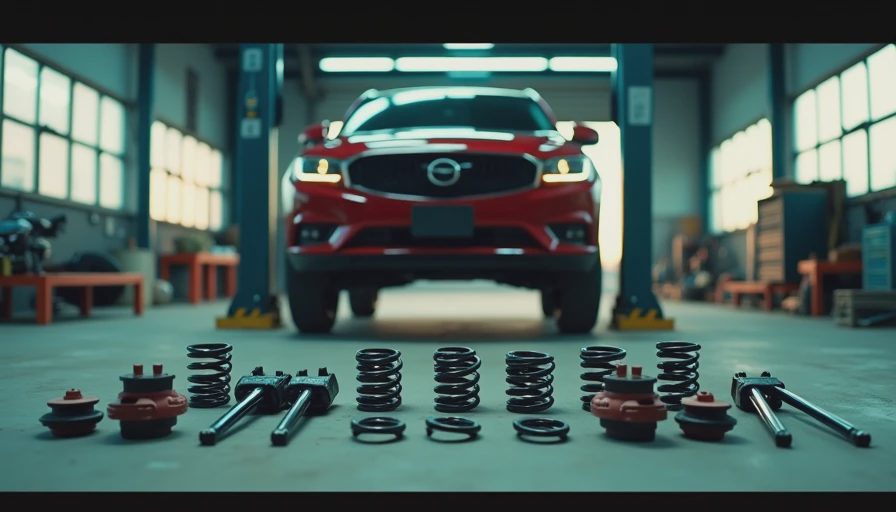
The suspension system is a collection of parts that keep the tire planted. There are control arms and bushings that locate the wheel, ball joints that let it pivot, tie rod ends that connect to the steering rack, and springs and shocks or struts that control movement. Sway bar links stabilize body roll in corners. Older trucks and muscle cars often have a solid rear axle with leaf springs. Knowing which piece is making noise saves you money. A clunk over small bumps is usually a sway bar link, a cheap and easy fix. A deep knock over speed bumps points to a lower ball joint or control arm bushing. A bouncing ride after a bump means the shock or strut is done.
What a Typical Suspension Repair Costs
In my shop, a pair of front struts with alignment runs between $450 and $750. Rear shocks run $250 to $500 for the pair. Lower ball joints with good parts like Moog come in around $250 to $450 including labor. A full set of control arms can push past $800 on a late-model SUV. A complete front end rebuild on a 2000s F-150 might cost $1,200 to $1,800. On a German premium sedan, expect $2,500. Suspension repair is one of the few areas where the price gap between vehicles is bigger than the gap between shops.
A 5-Minute Suspension Check You Can Do Right Now
Park on level ground and set the parking brake. Push down on a fender and let go. If the car bounces more than twice, the shocks or struts are weak. Have a buddy rock the steering wheel while you watch the tie rods and ball joints; any play or clicking is a red flag. Inspect the rubber boots for cracks or grease leaks. Run your hand along the front tires and feel for scalloped edges. That check takes five minutes, costs nothing, and tells you exactly where to begin a suspension repair.
The Parts Worth Spending On
I've seen cheap suspension parts fail in 10,000 miles and OEM parts last 100,000. The rule of thumb: never go cheap on steering and suspension. If you're doing a suspension repair, choose a middle-tier brand like Moog or Delphi. They use better bushings and grease fittings. KYB and Monroe are solid for shocks and struts. Avoid no-name ball joints from an auction site to save $30. A failed ball joint can let the control arm drop and you lose the wheel. That's not a repair bill, that's a crash. Pay the extra $20 for a warranty.
What You Can Tackle in a Weekend
Sway bar links are about as easy as it gets. On a Honda Civic or Chevy Silverado, you can swap both links in under an hour with hand tools. Shocks on older trucks are straightforward if the bolts aren't rusted solid. Grab jack stands, a breaker bar, and penetrating oil. If you've done brakes, you can handle rear shocks on most pickups. Ball joints need a press on many cars, but a ball joint press rental from the parts store gets you through one lower ball joint in an afternoon. Just be honest about your comfort level. A suspension repair you finish half-heartedly is worse than one a pro does right.
When to Hand It to a Professional
Some jobs I won't do without a lift. Coil spring replacement is one; a compressed spring can kill you if it slips. Alignments need a rack, and your car needs an alignment after almost any suspension repair, so you'll have a shop visit anyway. Do the parts yourself and pay $90 for the alignment. In the rust belt, budget extra time for a mechanic to torch off fasteners. It's not fun, but it's part of old-car life.
Final Thoughts
Suspension repair is the easiest way to make an old car drive like new. Jack up the front end and shake down the wheels. Check ball joints, torn boots, and worn bushings. Write down part numbers and call around for prices. Spend time diagnosing before spending money. If you have a project car, fix the suspension before chasing horsepower. A car that handles and stops like it should is worth more than an extra 50 horsepower.