Last month a customer rolled into Bay Three with a stack of receipts and a frustrated look. He'd just spent over $400 on a full set of ceramic brake pads for his daily-driver Silverado — the premium stuff, the kind the parts store guy swore would stop better, last longer, and keep his wheels cleaner. A thousand miles later, the truck stopped fine. But not better. Definitely not $400 better.
He asked me what I would've put on. I pointed to the shelf behind the counter where we keep a box of mid-grade semi-metallics. Forty-eight dollars an axle. Same stopping power in real-world driving, slightly more dust, and no marketing budget baked into the price.
This happens all the time. Guys walk into a parts store without knowing what they need, and they walk out with the most expensive option because it sounds advanced. Ceramic. Low-dust. Premium. The words work. The pads might not.
The Three Pad Compounds and What They're Actually For
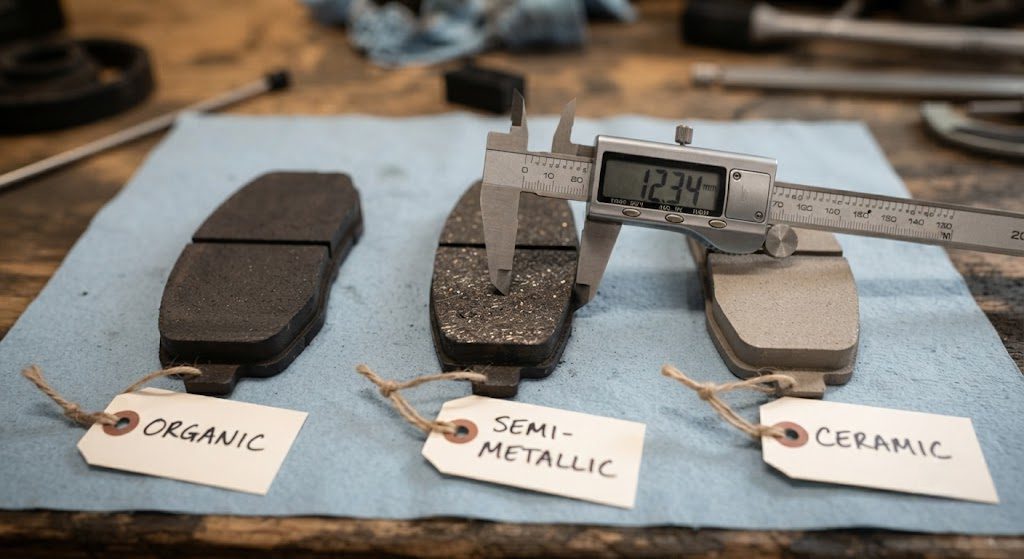
Every brake pad on the market falls into one of three categories: organic, semi-metallic, or ceramic. Each has a job. None of them are "best." Anyone who tells you otherwise is selling something.
Organic Pads — The Budget Daily
Organic pads are made from fibers, rubber compounds, and sometimes a little Kevlar mixed in for heat resistance. They're soft, quiet, and gentle on rotors. They also wear out faster than anything else on the shelf and fade hard when they get hot.
These belong on light commuter cars that never see highway speeds above 65 and never carry a load heavier than a trunk full of groceries. Think your grandma's Camry. For anything else, skip them. I've never installed organics at the shop unless a customer specifically asked for the cheapest option, and even then I warned them they'd be back sooner than they wanted.
Semi-Metallic Pads — The Workhorse
Semi-metallics are a blend of metal fibers — usually steel, copper, or iron — mixed into a friction compound. They stop harder than ceramics at low temperatures, handle heat better than organics, and cost about half what ceramics do. The tradeoff is noise and dust. They'll leave a dark film on your front wheels, and they might squeal a little when cold.
For trucks that tow, muscle cars that get driven hard, and any daily driver where stopping distance matters more than clean rims, semi-metallics are the right answer. I run them on my own Silverado and on the Chevelle. Leo Chase ran them on his old F-150 for years and swore by the bite they had at cold stops in Michigan winters.
The parts stores don't push these because the margin is lower. That's not your problem.
Ceramic Pads — Quiet, Clean, and Often Oversold
Ceramic pads are made from a dense ceramic compound with copper fibers mixed in. They're quiet, produce almost no visible dust, and last a long time under moderate use. For a luxury sedan that cruises at highway speeds and rarely sees aggressive braking, they're a solid choice. The braking is smooth, progressive, and silent — exactly what that audience expects.
Where ceramics fall short is in heavy-duty use. Under sustained high heat — like towing down a grade or repeated hard stops — they don't transfer heat as effectively as semi-metallics. The braking feels wooden and the stopping distance increases. They also cost more to produce, which means you're paying extra for a material that doesn't necessarily match your driving needs.
How to Do the Job Yourself in an Afternoon
Brake pads are one of the few repairs where the labor cost at a shop often exceeds the parts cost by a wide margin. Paying someone $120 an hour to turn four bolts per corner doesn't sit right with me, especially when the job is straightforward enough for a Saturday morning.
Tools You Actually Need
You need a jack and two jack stands — never work under a car supported only by a jack. A C-clamp or a proper caliper compression tool to push the piston back. A basic socket set, usually metric, covering 12mm to 17mm. A wire brush to clean the caliper bracket where the new pads slide in. Brake grease — the silicone kind, not petroleum-based, because petroleum grease swells rubber seals.
That's it. If you've got those tools and a flat surface to work on, you can do a pad swap on most vehicles in about two hours your first time, and under an hour once you've done it a few times.
The One Step People Skip
Clean the slide pins. Every caliper bracket has metal pins that the caliper slides back and forth on as the pads wear. Over time, old grease hardens and the pins seize. That's why one pad wears down to the metal while the other side still has material left — the caliper can't float evenly.
Pull the pins out. Wire-brush them clean. Apply fresh silicone brake grease. Reassemble. That five-minute step adds years to the life of your pads and prevents the uneven wear that sends people back to the parts counter convinced they bought bad parts.
What I Actually Recommend
If you drive a truck or an SUV, buy semi-metallic and don't overthink it. If you drive a commuter sedan and never push the brakes hard, ceramics are fine but not necessary. If you're on a tight budget and drive a lightweight car, organics will get you by — just check the pad thickness every oil change because they wear fast.
The only thing I'll tell you to avoid is the cheapest no-name pads from a brand you've never heard of. The friction material separates from the backing plate on those. I've pulled chunks of pad out of calipers and shown them to customers who couldn't believe they'd saved thirty bucks for that.
Brakes aren't complicated. The marketing just makes them sound that way.