There's a reason front-end shops love it when you bring in a car with a clunking suspension. Half the time, it's not some mysterious strut issue — it's a worn ball joint. This little pivot point is what connects your control arm to the steering knuckle, and when it goes, your wheel gets loose in ways that can leave you stranded or worse. In this article, I'll walk you through exactly how the joint wears, how to check it, what a replacement costs, and whether you can tackle the job in your own garage. If you've ever heard a pop while turning into a driveway, pay attention.
What This Joint Actually Does
A ball joint is a spherical bearing that sits between the suspension's control arm and the steering knuckle. Think of it like your hip joint: it lets the knuckle move up and down as the suspension compresses, while also allowing the wheel to turn side to side. Every car has at least one per front corner, and when you've got a double-wishbone setup, you're looking at an upper and lower joint on each side. On a MacPherson strut, there's usually only a lower joint, but it's doing all the work. Without this joint, your front tire couldn't steer and absorb bumps at the same time. That's why this part is so important.
Signs a Ball Joint Is Going Bad
The first symptom you'll probably notice is a clunk or a pop when you go over a bump or make a sharp turn. Then the truck might start pulling to one side, or the front tires start wearing funny on the inner or outer edge. The classic test is to jack up the front end, grab the tire at 6 and 12 o'clock, and rock it back and forth. If you feel play, the ball joint is loose. You can also check the rubber boot around the joint. If it's torn and grease is slinging out, you're already on the way to a breakdown. I've seen one fail completely on a highway once — the control arm dropped, and the wheel folded under the fender. That's not a fun breakdown.
What Wears Out a Ball Joint
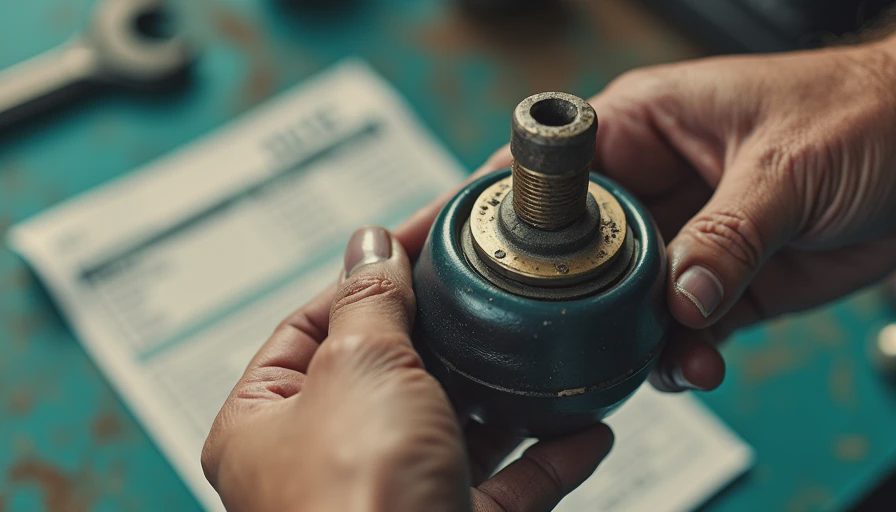
A ball joint wears from constant friction plus road grit. The grease inside is sealed by a rubber boot, and the moment that boot tears, water and sand get in and act like sandpaper on the bearing surface. Worn control arm bushings, bad wheel bearings, and an alignment that's been ignored for years all speed things up. So when a customer tells me it's just a noise, I don't just swap the joint — I look at the whole front end. On older trucks, joints can last 100,000 miles or more. On a daily driver that sees salt and potholes, you might be replacing them at 60,000. Mileage varies, but the failure pattern is always the same.
The Cost of a Ball Joint Replacement
If you're taking it to a shop, budget $200 to $400 per side at an independent shop. That includes the part, which is usually $40 to $120 for a decent unit from Moog, AC Delco, or a comparable brand, plus labor and the alignment you'll want when it's done. A dealer will push that to $500 or $600. On a 3/4-ton truck with a solid front axle, ball joints can cost $150 each, and the labor jumps because you're wrestling with a lot of weight. And don't skip the alignment: if the ball joint was worn out, the toe is almost certainly off. Throw in another $80 to $120 for that. The total on a full-size truck can easily land north of $700.
DIY Replacement: What You're In For
If your vehicle uses bolt-in ball joints, you can do it with a floor jack, jack stands, a breaker bar, and a hammer. Press-in ball joints need a ball joint press or a C-frame tool, and you can rent one from the auto parts store. The job is straightforward for a rear-wheel-drive pickup from the 90s or 2000s: unbolt the caliper, remove the rotor, pop the tie rod loose, and then separate the stud from the knuckle. On some Chevy and GMC trucks, you'll need an angle grinder to cut off the rivets that hold the old joint in. Once the new part is in, torque everything to spec and get an alignment. I've done this swap in about two hours on my own rig. If you've got a 4x4 with torsion bars or anything European, it gets trickier fast, and that's when you're better off paying someone.
When to Call a Pro
If you spot a torn boot or feel real play in the wheel, don't drive it at highway speed. That's not a joke: a failed joint is a safety-critical problem. When the stud snaps, you lose steering control, and it isn't something you can fix at the side of the road. Over the years, I've seen failed joints cause everything from a ruined fender to a rolled truck. If you're even halfway doubtful about your ability to do the job right, hand it to a professional. The $300 you save doing it yourself isn't worth the crash risk. But if you've got the tools, the time, and a level driveway, this job is a satisfying weekend project. Just have the alignment shop standing by.