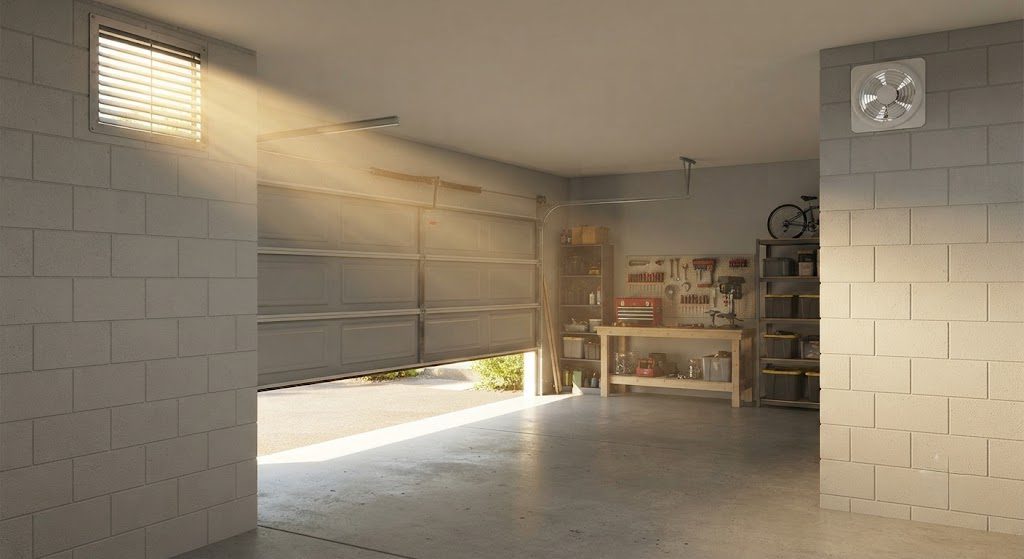
I didn't think about ventilation for the first three years I worked in my home garage. The door opened, the door closed, and that was the extent of my air management strategy. Then one August afternoon I walked into the garage after a week away and the smell hit me before I even reached for the light. Gasoline, stale air, and something musty that turned out to be mold growing on a cardboard box of old shop manuals I'd left on the floor.
A garage is a box. Four walls, a roof, a big door. Without airflow, that box traps everything — moisture from concrete, fumes from gas cans, off-gassing from paint and solvents, humidity from the outside air that condenses on cold metal at night. You can coat the floor, organize the tools, and light the place like a surgery suite, but if the air doesn't move, the garage is slowly damaging everything inside it.
Why a Sealed Garage Is a Problem
Modern houses are built tight. Insulated walls, weather-stripped doors, vapor barriers under the slab. That's great for the living room. It's terrible for a workspace. A tight garage with no ventilation builds up fumes, moisture, and heat, and has no way to shed any of them.
Condensation — The Silent Rust Factory
Here's what happens every night in an unventilated garage: the concrete floor, which stays cool from contact with the ground, meets warm humid air. The moisture in that air condenses on the slab. Then it condenses on your tool chest. Then it condenses on the exposed steel of your project car's engine block. Over time, that cycle of wet and dry produces surface rust on everything that isn't protected.
I've pulled socket rails out of drawers and found a fine layer of orange dust on chrome that was spotless six months earlier. That wasn't a leak. It was condensation — the same thing that fogs up a bathroom mirror after a hot shower. In a garage, it happens slowly and you don't notice until the rust shows up.
Fume Buildup You Can't Always Smell
A gas can with a plastic spout is not sealed. Neither is a can of paint thinner, a bottle of carb cleaner, or a jug of used oil waiting to go to the recycling center. All of those off-gas. In a sealed space, those fumes accumulate. Most of them aren't concentrated enough to be dangerous, but they're concentrated enough to make the garage smell like a chemical shed. More importantly, some of them are heavier than air and settle near the floor, right where a pilot light or a spark from a grinder could find them.
Passive Ventilation — The Foundation That Costs Almost Nothing
Before you buy fans or cut holes in walls, start with passive airflow. Passive ventilation means creating a path for air to move naturally — in low, out high, driven by wind and temperature differences. No motors, no wiring, nothing to break.
The Cross-Flow Rule: Low In, High Out
The simplest setup is two vents on opposite walls. One low, near the floor, for intake. One high, near the ceiling, for exhaust. Hot air rises, so the high vent releases the heat and fumes that collect at the ceiling. Fresh air gets pulled in through the low vent to replace what's leaving. This works even on a calm day because the temperature difference between inside and outside creates a natural draft.
For a standard two-car garage, a pair of 12-inch-by-12-inch louvered vents — one low on the prevailing wind side, one high on the opposite wall — will move enough air to keep the space dry under normal conditions. Add insect screens on the outside to keep wasps and mice from moving in.
Soffit Vents — The Overlooked Solution for Attached Garages
If your garage is attached to the house, you probably can't cut through the shared wall for venting. But you've got soffits — the underside of the roof overhang. Soffit vents are standard in attic construction, and they work just as well for a garage. A continuous soffit vent on one side paired with a gable vent or roof vent on the opposite side creates the same low-to-high airflow pattern without punching holes in your walls. This is how I vented my own home garage after the mold incident, and the musty smell was gone within a week.
Active Ventilation — When You Need Real Air Movement
Passive vents handle humidity and light fumes. They don't handle welding smoke, paint overspray, or the kind of heat that builds up when you're running an engine in an enclosed space. For that, you need a fan.
Wall-Mounted Exhaust Fans — Placement Is Everything
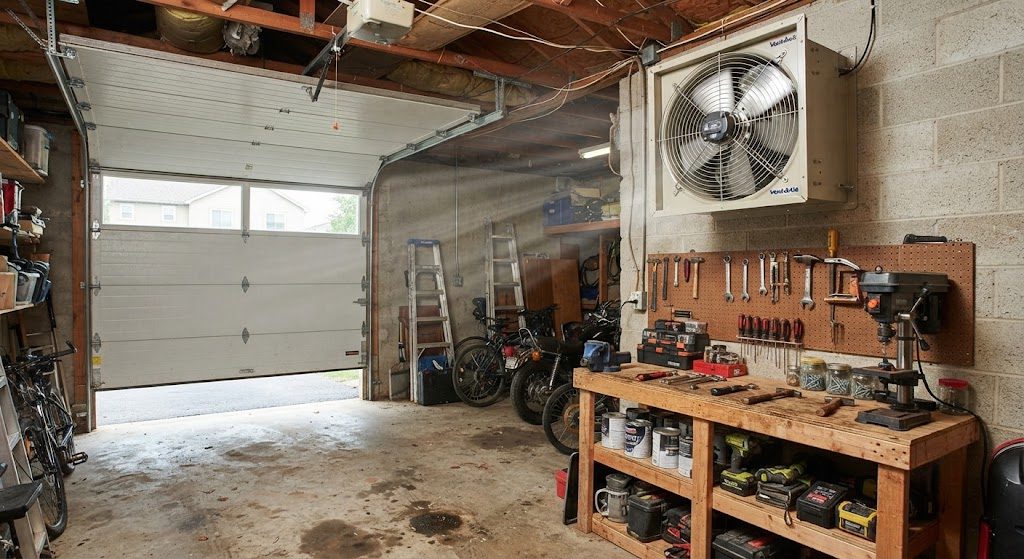
An exhaust fan belongs as high as possible on the wall opposite your main intake. This pulls fresh air across the entire garage, picks up fumes and heat along the way, and dumps them outside. Size the fan to your space: a 1,200 CFM fan clears a 400-square-foot garage in about three minutes. That's enough for general ventilation and light welding. If you're spraying paint, you need more — closer to 2,000 CFM and an explosion-proof motor rated for flammable vapors.
Mount the fan on rubber isolators if the wall it's attached to is shared with the house. A hard-mounted fan transmits vibration through the framing, and the hum will drive anyone in the next room crazy.
The Budget Option That Works
If you're not ready to cut a hole for a permanent exhaust fan, a box fan in a window does the job for occasional use. Set it to blow outward in a window on the side of the garage opposite the main door. Crack the garage door a few inches at the bottom for intake. It's not pretty, but it clears smoke and fumes fast and costs twenty dollars.
What Happens in Winter — Ventilation Without Freezing
The catch with ventilation is winter. Every cubic foot of air you exhaust is a cubic foot of cold outside air that comes in to replace it. In a working shop like mine, I keep the heat at around 50 degrees through the winter and the exhaust fan only runs when I'm actively welding or running an engine. The passive vents do the daily work.
For a home garage that's heated, you want controllable vents — louvers that close when you don't need airflow. A pair of aluminum louvered vents with a pull-chain shutter lets you seal the garage in cold weather and open it up in spring. Keep the passive system closed during the coldest months, run the exhaust fan only when you're producing fumes, and open everything back up when the outside temperature climbs above freezing.
A garage that breathes is a garage that stays dry, smells normal, and doesn't rust your tools. You can't see airflow. You can't bolt it to a workbench or post it on Instagram. But you notice it the first time you walk into the space and the air feels fresh instead of stale. That's when the garage stops being a box and starts being a room.