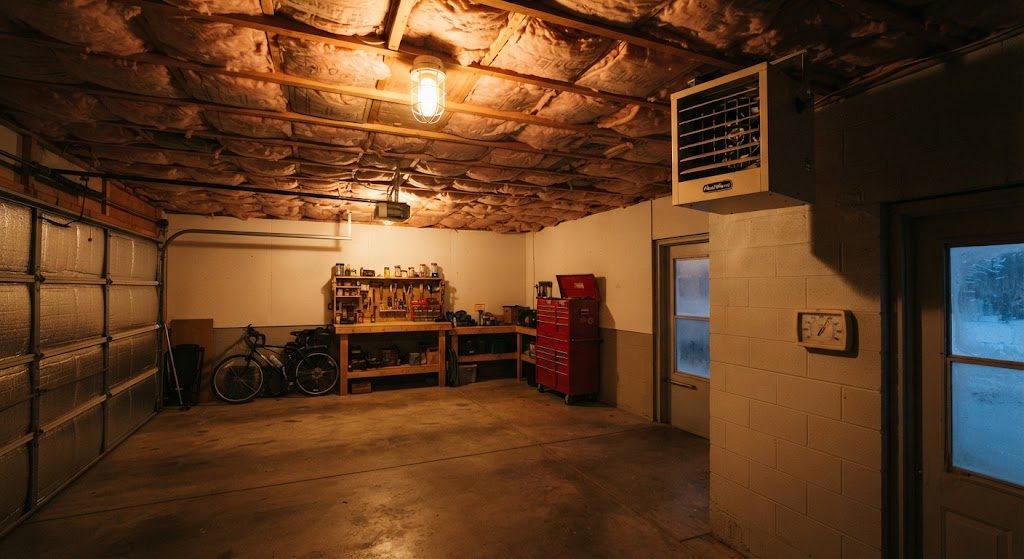
The first winter I worked in my home garage, I tried to heat it with a kerosene torpedo heater. The kind that sounds like a jet engine and burns through five gallons of fuel in a shift. It threw enough heat to keep my hands warm, but it also filled the garage with fumes, condensation, and enough noise that I couldn't hear the radio. By February, every tool in my chest had a thin film of rust, and I'd spent more on kerosene than I did on the heater itself.
That was twenty years ago. I've learned a lot since then about what it actually takes to keep a garage warm through a real winter. Not warm enough for a t-shirt. Warm enough to work. Warm enough that the concrete doesn't sweat, the tools don't rust, and you can feel your fingers when you're turning a wrench at 9 p.m. on a Tuesday in January.
Insulate Before You Buy a Heater
The biggest mistake I see is guys buying a big heater for an uninsulated garage. They fire it up, the space gets warm for an hour, and then the heat disappears straight through the walls and the roof. You can't heat a garage that won't hold heat. The heater is step two. Step one is keeping the heat you generate from leaving.
The Ceiling Goes First
Heat rises. In an uninsulated garage with an open ceiling, every BTU you produce goes straight up through the roof. If you only insulate one surface, make it the ceiling. Fiberglass batts between the joists are the budget option — R-30 is the minimum for a garage ceiling in a cold climate. Blown-in cellulose is better for coverage but requires a machine. Rigid foam boards with foil facing are the premium route, and they double as a radiant barrier that reflects heat back down into the space.
I insulated the ceiling of my home garage in a single weekend. The difference was immediate. A space heater that struggled to raise the temperature ten degrees was suddenly holding it steady. That's when I understood that insulation isn't a material — it's a return on investment that pays out every month on the utility bill.
Walls and the Garage Door Are Next
Wall insulation matters less than the ceiling, but it still matters. If your garage has finished drywall, you can blow cellulose or injection foam into the stud cavities without tearing anything down. If the walls are open, fiberglass batts are cheap and effective. R-13 for 2x4 walls, R-19 for 2x6.
The garage door is the biggest heat leak in the room. A single-layer steel door has an R-value of about R-1. That's almost nothing. Replacement doors with polyurethane insulation can hit R-18, but they're expensive. The retrofit option is rigid foam board panels cut to size and glued to the inside of each door section. It's not pretty, but it works. I did this on my home garage door for about sixty dollars in materials. The door got heavier — I had to adjust the spring tension to compensate — but the garage held heat overnight instead of dropping to outside temperature by morning.
Choosing a Heater That Matches the Space
Once the insulation is in place, the heater becomes a math problem. How many BTUs do you need, and what fuel source makes sense for your setup. Guessing wrong means you're either cold all winter or burning money.
Electric — Clean, Quiet, and Predictable
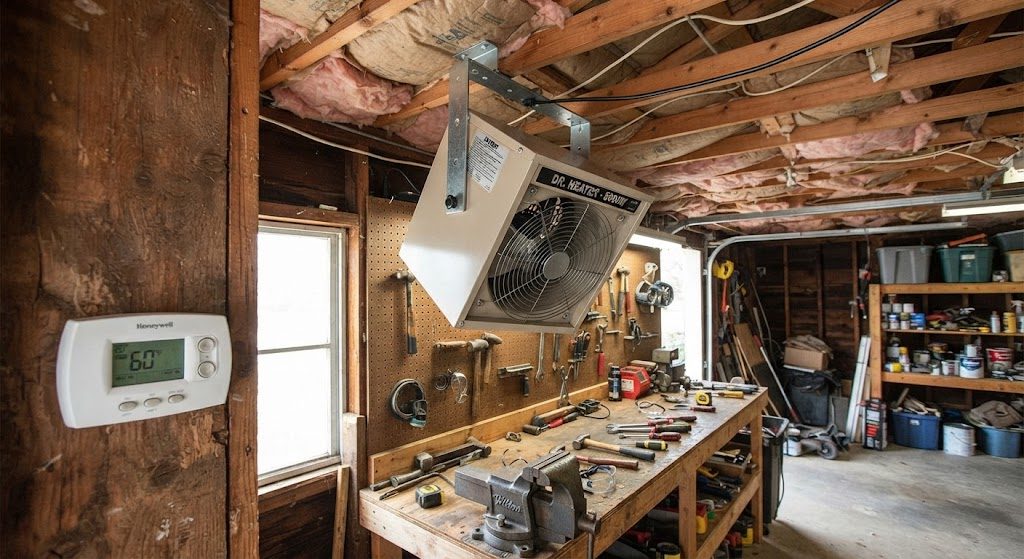
Electric is the simplest option. No venting, no fuel storage, no combustion byproducts. A 5,000-watt electric unit heater puts out about 17,000 BTUs, which is enough for a well-insulated two-car garage in a cold climate. Hardwire it to a 240-volt circuit, mount it on the ceiling pointed down at the work area, and control it with a line-voltage thermostat.
The downside is operating cost. Electricity is more expensive per BTU than natural gas or propane in most places. In my three-bay shop, I run electric heat because I don't have a gas line and I don't want to deal with propane tanks. I keep the thermostat at 50 degrees when I'm not in the building, bump it to 60 when I'm working, and the monthly bill is predictable. For a home garage that gets used evenings and weekends, electric is usually the right call.
Natural Gas — The Workhorse If You've Got a Line
If your garage already has a natural gas line, a vented gas unit heater is the cheapest way to produce a lot of heat. These mount on the ceiling and vent through the wall or roof. They're loud — the fan kicks on with the burner — but they'll take a freezing garage to comfortable in fifteen minutes. The catch is installation. You need a gas line run to the unit, a properly sized vent, and clearance from combustible materials. This is not a DIY project unless you're already comfortable running gas lines and pulling permits.
Propane and Kerosene — Know the Tradeoffs
Propane torpedo heaters and kerosene units are portable, powerful, and cheap to buy. They also produce carbon monoxide and a lot of moisture. Every gallon of kerosene burned releases roughly a gallon of water vapor into the air. That moisture condenses on cold metal — your tools, your project car, your tool chest — and accelerates rust. These heaters are fine for a job site or an emergency thaw. They're not a daily heating solution for a garage you care about.
The Thermostat Strategy That Saves Money
Don't heat a garage like a house. You don't need 68 degrees to work comfortably. You need the chill gone and the concrete dry. I keep my shop at 50 degrees overnight and when it's empty. That's warm enough to prevent condensation and keep fluids from freezing, and cool enough that the heater isn't running constantly.
When I'm working, I bump it to 60. That's sweater temperature, not t-shirt temperature, but it's comfortable for physical work. If I'm doing bench work — rebuilding a carburetor or sorting small parts — I'll add a small radiant heater pointed at the bench instead of heating the whole shop. Spot heat where you need it is always cheaper than heating the entire volume of the building.
A Programmable Thermostat Pays for Itself
If your heater runs on a basic dial thermostat, replace it with a programmable unit. Set it to drop to 50 at night, come up to 60 an hour before you typically walk in, and drop back down when you leave. The first month I did this, my electric bill dropped almost thirty percent. The heater ran less, the shop stayed dry, and I stopped heating an empty building for twelve hours a day.
A warm garage isn't a luxury. It's the thing that makes the space usable from November through March. Insulate first, size the heater to the space, and let the thermostat do the thinking. Your tools will stay rust-free, your concrete will stay dry, and you'll actually want to be out there when it's ten degrees and snowing.