I’ve written about flooring, lighting, ventilation, storage, and workbenches. All of it matters. But none of it matters as much as the fridge.
When I opened Callahan Auto Works in 2016, the building had no lift, no air lines, and a floor that needed three coats of sealer before I’d let a car drip oil on it. But the fridge was plugged in on day one. It was a used unit I picked up from a restaurant that was renovating — stainless steel, commercial grade, the kind built to survive health inspectors and clumsy line cooks. It had dents. It had a compressor that rattled for the first ten seconds on startup. It was perfect.
That fridge has outlasted two air compressors. It’s seen the Chevelle on a lift more times than I can count. It’s held cold beer through every frustration and every small victory this shop has produced. A garage without a fridge isn’t incomplete. It’s missing the point.
The Fridge Is the Anchor
Every garage has a center of gravity. In some, it’s the car. In others, it’s the workbench or the tool chest. In mine, it’s the fridge. Not because I spend all day opening it, but because it signals something about the space.
A Fridge Means You’re Staying
A garage with a fridge is a garage where someone plans to spend time. You don’t put a refrigerator in a room you’re just passing through. You put one in a room where work happens, where breaks happen, where a Saturday afternoon turns into Saturday evening without anyone looking at a clock. The fridge turns the garage from a parking pad into a destination.
When a buddy shows up to help pull a transmission or bleed a brake system, the first thing they see is the open bay. The second thing is the fridge. It says: there’s a cold one waiting when we’re done. That matters. It’s the difference between a workspace and a clubhouse.
What the Fridge Tells You About the Owner
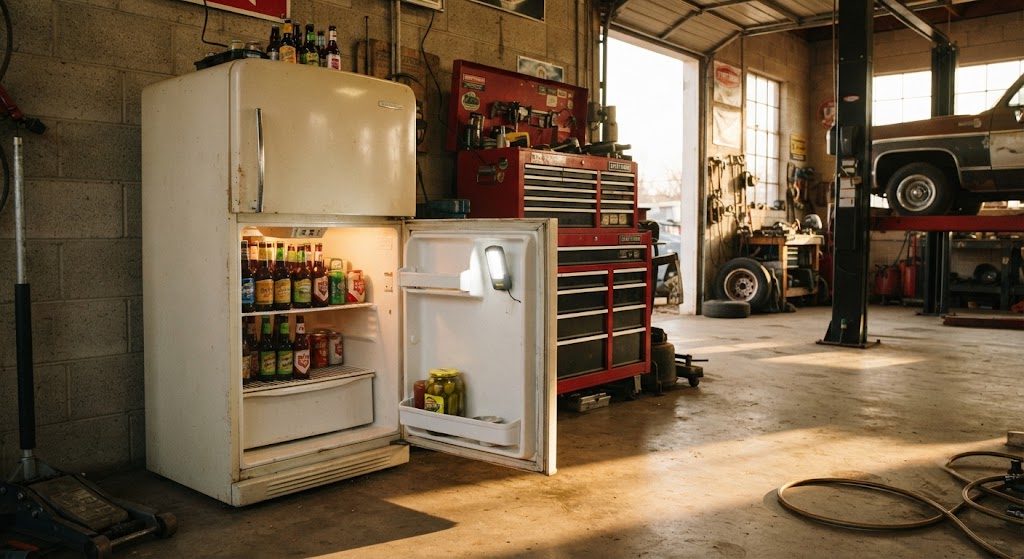
Open the fridge in any garage, and you’ll learn something about the person who works there. Mine has beer on the top shelf, water and Gatorade in the middle, and a jar of pickles in the door that’s been there since 2019. No organization system beyond gravity and habit. The crisper drawer holds shop towels in the summer — cold water on a rag cools you down faster than anything else.
A garage fridge doesn’t need to be Instagram-ready. It needs to be cold, stocked, and close to the work. If it’s too far from the lift, you won’t use it. If it’s too nice, you’ll worry about scratching it. The best garage fridge is the one somebody else was throwing away.
Where the Fridge Goes
Placement is simple but not obvious. The fridge should sit against a wall that’s not in the main workflow but not so far away that grabbing a beer means leaving the conversation. In my shop, the fridge is in the corner between Bay Two and Bay Three, a straight shot from the workbench and close enough that I can hear the compressor kick on when the beer is getting warm.
Don’t Put It Next to the Welder
Fridge compressors don’t like heat, and they really don’t like grinding dust. Keep the fridge away from the welding cart and the bench grinder. Metal dust gets pulled through the condenser coils and shortens the life of the compressor. I learned this the hard way in my home garage. The replacement fridge sits on the opposite wall, and it’s been running fine for eight years.
Keep It Off the Floor If You Can
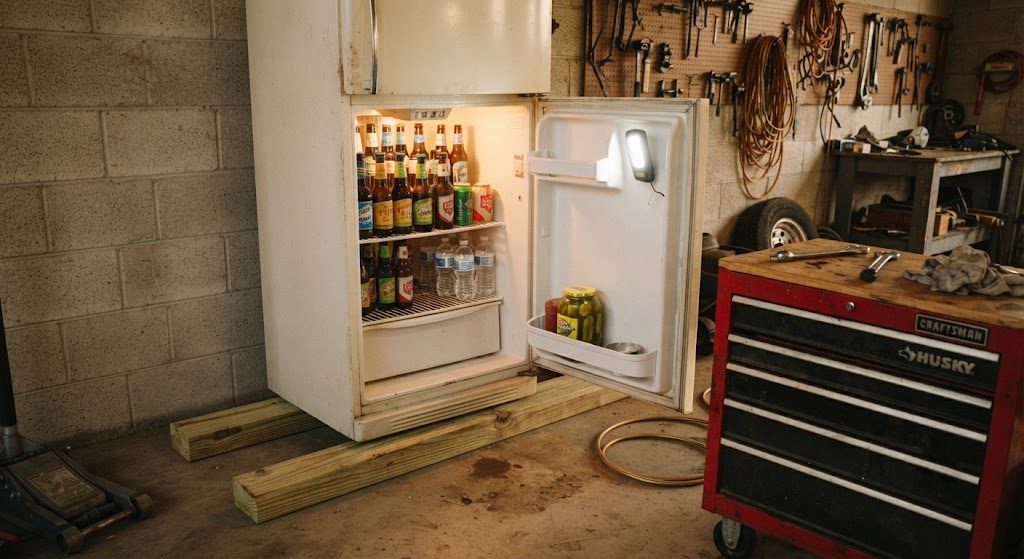
Concrete sweats, and a fridge sitting directly on a damp slab will rust through the bottom pan eventually. A couple of pressure-treated two-by-fours under the fridge feet lifts it half an inch and lets air circulate underneath. I’ve done this on every garage fridge I’ve ever owned. The bottom of the unit stays dry, and the compressor breathes a little easier.
The One Rule That Keeps It From Going Feral
Every garage fridge needs a rule, and the rule is non-negotiable: you take the last cold one, you replace it before you leave.
This isn’t about being stingy. It’s about showing up the next night ready to work and finding the fridge empty. Nothing kills momentum faster than reaching for a beer that isn’t there. The rule applies to everyone who walks into the shop — me included. I restock the fridge on Friday afternoons, and by Sunday night it’s usually half-empty. Monday morning I start the week with a cold shelf, and the cycle repeats.
The rule also applies to water and Gatorade, because dehydration is a real thing when you’re working under a hot hood in August. If you take the last water, you throw a new case in. It’s not complicated. It’s just how a working fridge stays working.
Why the Fridge Comes First
I started this series of articles with the hierarchy of a working garage: fridge first, workbench second, floor coating a distant eighth. I’ll end it the same way. The fridge is the thing that makes all the other things possible. The late nights. The long Saturdays. The moment at 11 p.m. when the timing finally lines up and the engine settles into an idle and you crack a cold beer and stand there in the quiet, looking at what you built.
The floor can wait. The lights can wait. The epoxy and the matching tool chests and the hex-grid ceiling — all of it can wait. Get the fridge first. Plug it in. Stock it. The garage stops being a garage the moment you stop wanting to be in it. The fridge makes you want to stay.