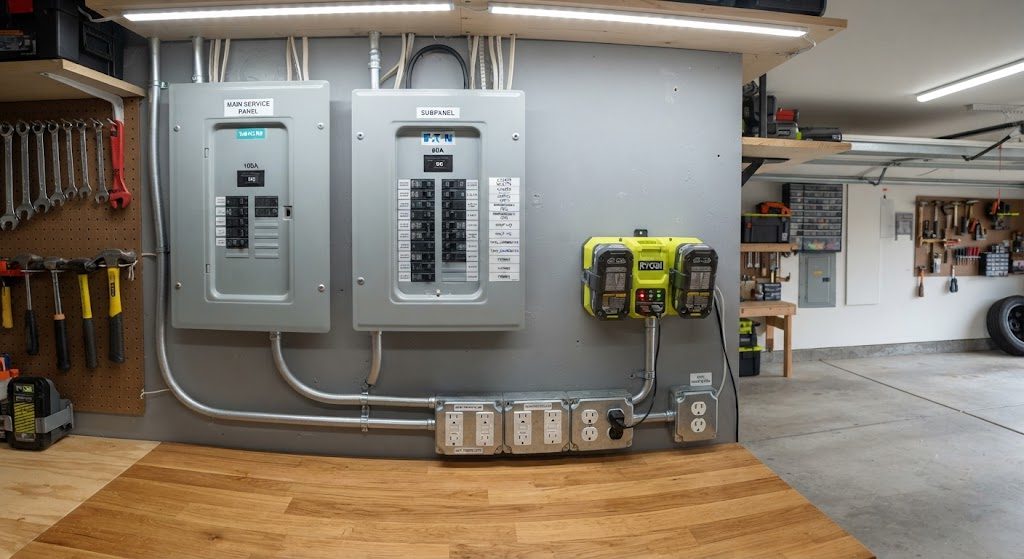
The first time I tripped the breaker in my home garage, I was 22 years old and trying to run a pancake compressor off an extension cord plugged into the same outlet as a drop light. The compressor kicked on, the lights went out, and I stood there in the dark with an air hose in my hand wondering which breaker even fed the garage. Turned out it was the same circuit as the bathroom and the hallway lights. My wife was not happy.
Builders treat the garage like an afterthought when it comes to electrical. One outlet on the ceiling for the door opener, maybe one on the back wall if you're lucky, and a single 15-amp circuit that's already doing work somewhere else in the house. That's fine if the garage is a parking pad. It's useless if the garage is a workshop.
I rewired my home garage in 2010 and designed the electrical for the shop from scratch in 2016. Both spaces have run without a tripped breaker, a flickering light, or a smoking outlet since. Here's what actually matters.
The Subpanel Is the Foundation
If your garage is attached to the house and you're running more than a couple of power tools, a subpanel is the single best upgrade you can make. A subpanel gives the garage its own breaker box, fed from the main panel, with its own circuits dedicated to the tools, lights, and outlets you're actually using.
Why One Circuit Isn't Enough
A standard 15-amp circuit at 120 volts delivers about 1,800 watts before it trips. A mid-size air compressor pulls 1,500 watts on startup. A space heater pulls 1,500 watts by itself. Run both on the same circuit and you're standing in the dark. Add lights, a battery charger, and a radio, and you're tripping the breaker without even trying.
A subpanel lets you split the load. Lights on one circuit, outlets on another, a dedicated 240-volt circuit for a bigger compressor or a welder. When I wired the shop, I put in a 100-amp subpanel with room for twelve breakers. I'm only using eight of them. The empty slots cost nothing and mean I can add a circuit without pulling the panel apart.
What a Subpanel Actually Costs
The panel itself runs about a hundred dollars. The wire from the main panel is the expensive part — copper isn't cheap, and you need heavy gauge for a long run. An electrician will charge somewhere between eight hundred and two thousand dollars depending on distance, access, and whether your main panel has room for a new breaker. It's not cheap, but it's cheaper than rewiring the whole garage twice because you outgrew a single circuit.
Outlets Where You Actually Need Them
The garage outlet layout is a puzzle that solves itself once you know where the work happens. I put outlets where my hands are, not where the builder decided a plug might look nice.
Workbench Outlets — Every Four Feet
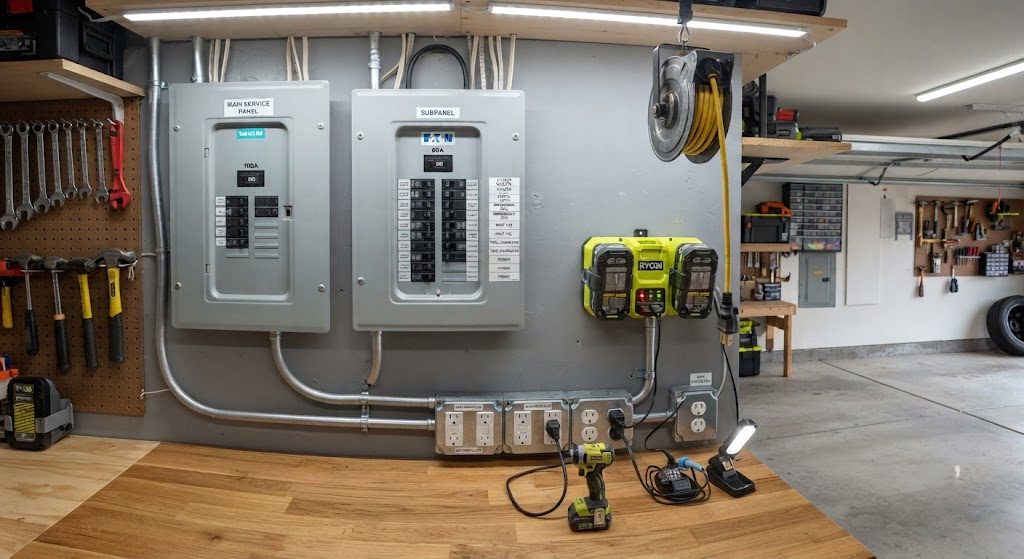
My main workbench has an outlet every four feet, mounted at 42 inches off the floor — above the bench surface, not below it. That means I can plug in a grinder, a drill charger, and a work light without an extension cord and without crawling under the bench to find the plug. Every outlet on the bench circuit is GFCI-protected, with the first outlet in the chain providing protection for the rest.
Ceiling Outlets for Cord Management
The best outlet I ever installed was in the ceiling, right above Bay Two. A retractable extension cord reel hangs from it, and I can pull it down anywhere in the bay without a cord snaking across the floor. Overhead outlets also work for cordless tool chargers mounted on shelves, for a hanging shop light, or for a garage door opener that isn't sharing a circuit with anything else.
Outdoor Outlets — The One Most People Forget
If you ever work in the driveway — and you will, because some jobs need more room or better ventilation — put a GFCI outlet on the outside wall near the garage door. You'll use it for a pressure washer, a shop vac, or a work light when you're chasing a problem that won't fit inside.
Lighting Circuits — Keep Them Separate
Never put your lights on the same circuit as your tools. If a saw or a compressor trips the breaker, you don't want to be standing in the dark with a spinning blade. I put all the shop lights on a dedicated 15-amp circuit. It's overkill for LED fixtures, but it means nothing I do with a tool can kill the lights.
Switch Placement That Makes Sense
The light switch for each bay is on the wall right inside that bay's overhead door, at arm height. I can hit the lights before I walk into a dark shop, and I can shut them off on the way out without backtracking. A three-way switch setup at the man door and the main bay door is the cleanest solution if you're wiring from scratch.
What I'd Do Different Today
I wired the shop for what I needed in 2016. I should have wired it for what I might need in 2026. If I were doing it again, I'd run a second 240-volt circuit to the far bay — not because I need it now, but because installing it later means opening walls. I'd also put an outlet in the floor near the lift, which would save me the extension cord I still use every time I put a car on the rack.
A garage that's got enough power, in the right places, on the right circuits, stops being a fight. The lights stay on. The tools run. The breaker doesn't trip when you're in the middle of something important. That's not asking for much. It's asking for what a workshop should have had in the first place.