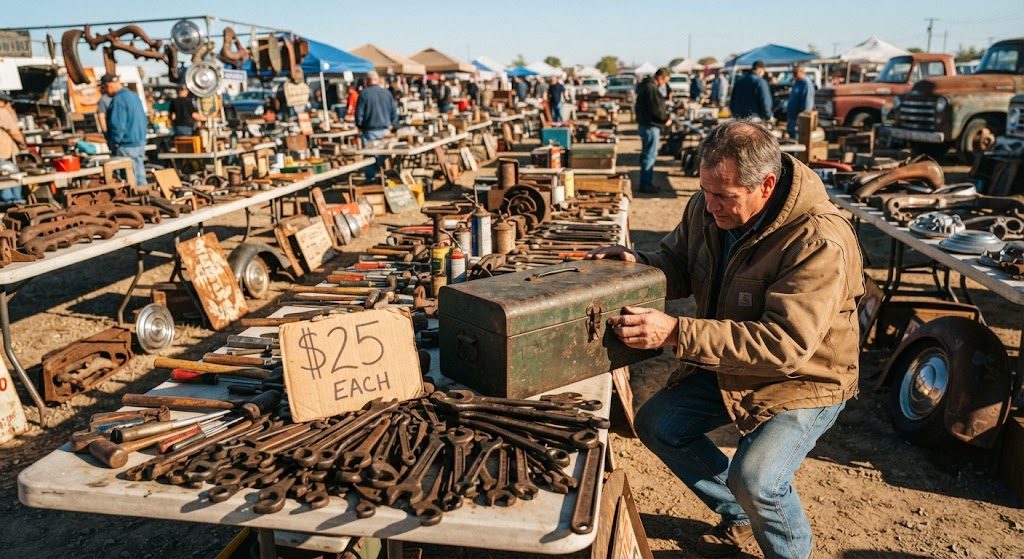
I've been walking swap meets since I was old enough to carry a toolbox. Back then it was about parts — Quadrajets, alternators, door panels for whatever project was eating my paycheck that month. Somewhere along the way, the mission changed. I started seeing the swap meet as a hardware store for the garage itself.
The best shelf in my shop came from a swap meet. So did the vise, the old porcelain light fixture over the workbench, and a metal cabinet that's been holding my paint cans since 2017. All of it for less than the cost of one trip to the home center.
If you're building a garage that works — not one that just looks good in photos — the swap meet is your best supply chain. You just have to know what's worth grabbing.
What to Buy: Garage Infrastructure at Swap Meet Prices
The beauty of a swap meet is that most people are there for car parts. That leaves the garage-building stuff to the guys who see past the greasy cardboard boxes.
Old Tools — Better Than New at a Tenth the Price
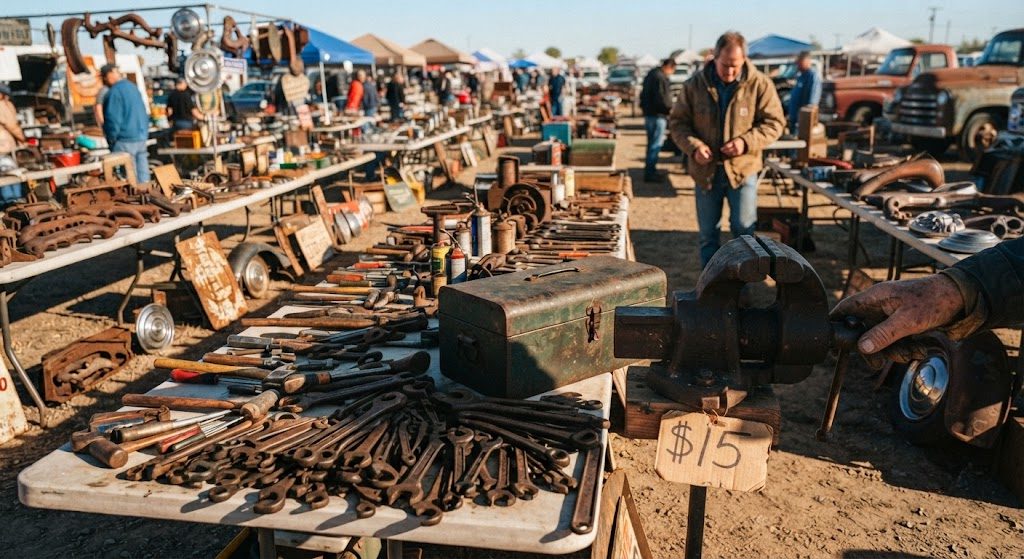
The wrenches, sockets, and screwdrivers you find at a swap meet are almost always American-made, forged before planned obsolescence was a business model. I've pulled Snap-on and old Craftsman wrenches out of dollar bins because they had surface rust. Rust wipes off. The steel underneath is better than anything on the shelf at a box store.
Look for hand tools with forged markings, not laser-etched logos. Bring a small magnet — if it sticks hard to chrome, the plating is thin and the steel underneath might be questionable. If you spot a bench vise, buy it. Old Wilton and Reed vises sell for hundreds restored, and I've seen them at swap meets for forty bucks because the seller didn't want to carry it back to the truck.
Industrial Lighting — Character You Can Work Under
Porcelain pull-chain fixtures, caged trouble lights, old factory pendants — these show up at swap meets because people rip them out of basements and barns and don't know what to do with them. Rewire them, hang them over the workbench, and you've got lighting that looks good and actually throws useful light. I found a 1940s factory light at a swap meet in Monroe six years ago. It's hanging over my bench right now, and it's survived more voltage spikes than any LED fixture I've bought.
Metal Cabinets and Shelving — Garage Storage That Doesn't Sag
The particle-board shelving from the home center sags after two years of holding oil bottles and brake fluid. Old metal storage cabinets don't. They're heavy, ugly, and usually painted a color nobody picked on purpose — olive green, institutional gray, that yellow-beige that screams 1970s shop class. But they're built like vaults. I found a 6-foot steel cabinet for twenty dollars because it was rusty on the bottom. Sanded the rust, shot it with black paint, and it's been holding spray cans ever since.
What to Walk Past: The Garage Decor That Doesn't Belong in a Working Space
Swap meets are full of things that look like they belong in a garage but don't survive actual work. Knowing the difference saves money and storage space.
Rusty Signs — Fine for a Man Cave, Not a Shop Wall
Vintage gas station signs and old oil company porcelain are everywhere at swap meets, and the prices have gone crazy. I like them. I own a few. But they don't help you build anything, and they take up wall space that could hold wrench rails or a parts rack. If you've got bare walls and some extra cash, grab one. If you're still trying to figure out where your tools are going, walk past.
"Vintage" Power Tools That Are Actually Fire Hazards
An old electric drill with a frayed cord is not a collectible. It's a trip to the emergency room. I've seen guys pay good money for 1950s bench grinders with cracked wiring and missing guards. Unless you know how to rewire a motor and source the right bearings, leave the old power tools to the restoration specialists.
When to Haggle: The Rules of Engagement
The swap meet runs on cash and conversation. Haggle wrong, and the seller remembers you as the guy who tried to steal from his table. Haggle right, and you're the guy he sets things aside for next time.
Bundle to Drop the Price
The best tactic isn't lowballing. It's bundling. Point at three items instead of one, and ask "What would you take for all three?" Most sellers will knock ten or fifteen percent off the total without you having to ask for a discount. You get a better deal, and the seller clears more inventory. Both sides win.
Know When the Price Is Already Right
If a vise is marked twenty dollars and it's in working condition, just pay the man. Grinding someone down on an already fair price is how you get a reputation as the guy nobody wants to see walking up the aisle. I've been on both sides of the table. I remember the guys who treated me fair, and I set parts aside for them at the next meet. Leo Chase once passed on a perfectly good torque wrench because he wanted to save three dollars. It was gone when he came back.
Sunday Afternoon Is the Window
The best deals happen in the last two hours of the last day. Sellers are tired, they don't want to pack everything back into the truck, and cash talks louder than it did on Saturday morning. Show up late, be ready to carry your purchases away immediately, and be the easy customer they're glad to deal with.
Your garage is a long-term project. The swap meet is where you find the pieces that make it yours — not a showroom, not a catalog, but a place built from someone else's cast-offs that turned out to be exactly what you needed.