The first shelving unit I bought for my garage was a particle-board special from a big-box store. Forty dollars, adjustable shelves, looked fine in the aisle. I loaded it with paint cans, oil bottles, and a couple of brake rotors. Six months later, every shelf had a sag in the middle like a hammock. By month eight, the bottom shelf collapsed and dumped three gallons of coolant onto the concrete.
Garage storage isn't furniture. It's infrastructure. The shelves you put up have to hold serious weight — fluids, parts, tools, hardware — in a space that cycles through heat, cold, and humidity. The wrong materials fail fast. The right ones disappear into the background and you never think about them again. That's the goal.
The Shelving Materials That Actually Last
Everything starts with what the shelf is made of. There are three materials worth considering for a garage, and everything else is a waste of money.
Steel Shelving — The Lifetime Purchase
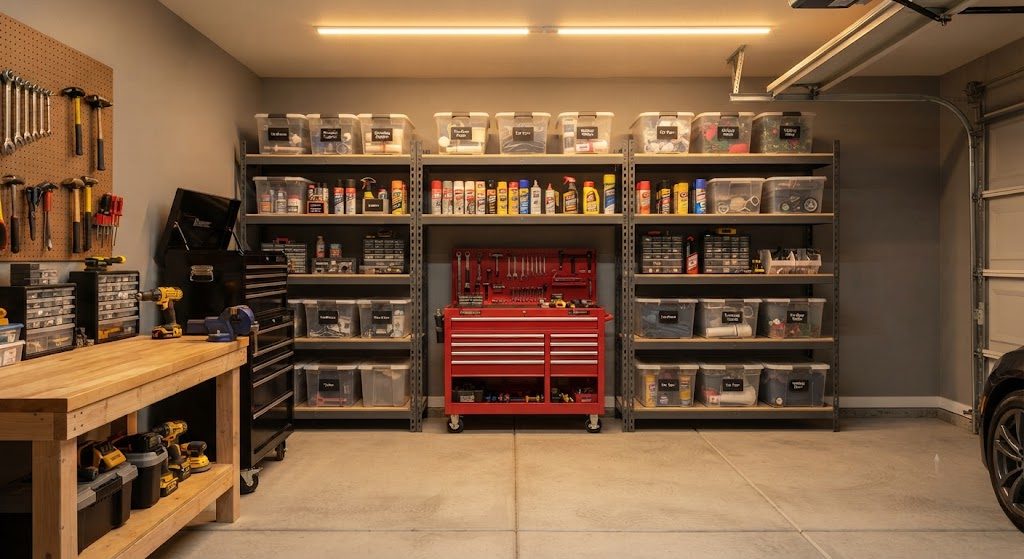
Steel shelving units with wire decks or solid steel shelves are the standard for a reason. They don't warp, don't absorb moisture, and don't care about temperature swings. A good steel unit rated for 800 pounds per shelf costs about a hundred dollars for a four-foot-wide, six-foot-tall unit. That sounds steep compared to the forty-dollar particle board. It's not. The steel unit will outlast your time in the garage.
Wire decks have one advantage: they let dust and small debris fall through instead of piling up. Solid steel shelves collect everything. Neither one fails under load. I've got three steel units in the shop, installed in 2016, and they look exactly the same as the day I assembled them.
Plywood and 2x4s — The DIY Option That Works
If you've got more time than money, framed plywood shelves are the best value available. Build them with 2x4 framing and 3/4-inch plywood decks. Not OSB — OSB swells when it gets damp and loses strength. Use actual plywood, and seal it with a coat of polyurethane or boiled linseed oil before you load it up.
The frame matters. Every shelf should have a 2x4 ledger screwed into the wall studs with 3-inch structural screws, plus vertical supports at both ends and at the midpoint if the shelf is longer than four feet. A properly framed plywood shelf will hold more weight than any store-bought unit at the same price. I built a set in my home garage in 2011 that's still holding transmission fluid and jack stands without a creak.
What to Avoid
Particle board. MDF. Anything with a vinyl coating that peels off in sheets. Plastic shelving units from the home center that click together — those are for closets, not garages. The first hot day turns the plastic brittle, and the first heavy load cracks the connectors. I've helped too many neighbors clean up collapsed plastic shelves to count.
Where Shelves Should Go
The back wall of the garage is the default location, but that's only half the answer. Shelves work best in zones, just like lighting and outlets.
Above the Workbench — Frequently Used Items
The shelf directly above the workbench is for things you grab mid-job. Brake cleaner, shop towels, anti-seize, penetrating oil, a magnetic parts tray. Keep it shallow — eight inches deep max — so you can reach everything without leaning over the bench. I mount this shelf at 48 inches above the bench surface, which leaves clearance for a vise and enough room underneath for a bench grinder.
High Shelves — Long-Term Storage
The space near the ceiling, above head height, is for things you use once a season or once a year. Holiday decorations, spare tires, that third jack stand set you bought because it was on sale. These shelves can be deeper — 16 to 24 inches — because you're not reaching into them daily. I use clear plastic bins with labels on the high shelves. Cardboard boxes up high are a mistake. They get dusty, they hide what's inside, and they're a fire hazard in a space where you're grinding and welding.
Under-Bench Storage — The Forgotten Zone
The space under a workbench is prime real estate that usually fills up with random junk. A rolling tool cart parked under the bench gives you drawers that pull out and tuck away. If you don't need rolling storage, a single fixed shelf six inches off the floor holds heavy items — floor jack, jack stands, a creeper — without blocking access to the bench.
The Labeling Habit That Saves Hours
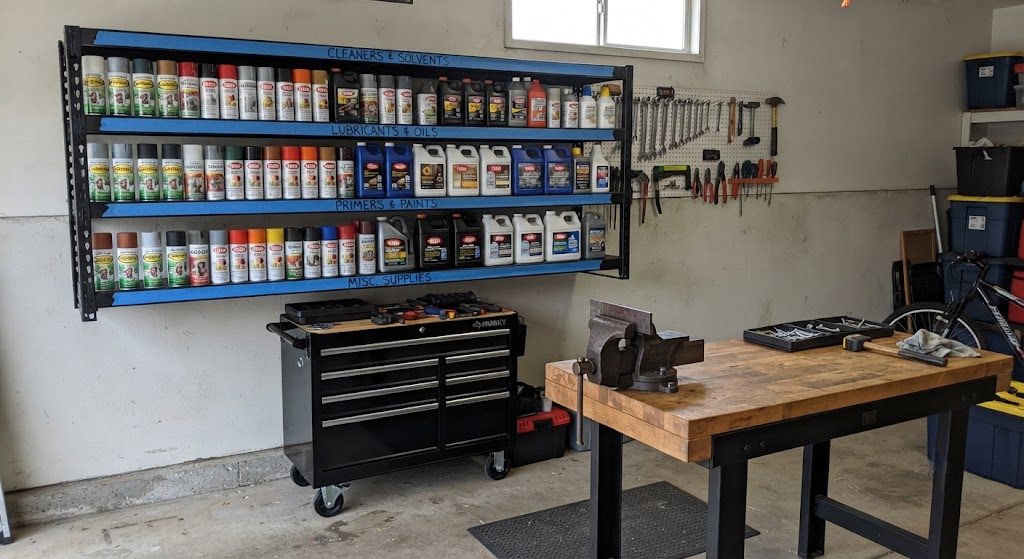
I don't care how good your memory is. After six months, you won't remember which bin has the electrical connectors and which one has the plumbing fittings. Label everything. Blue painter's tape and a black marker work fine. So do adhesive label pockets with index cards. The label doesn't need to be pretty. It just needs to be accurate.
I label bins by category, not by individual part number. One bin says "Hose Clamps." Another says "Wire Connectors." Another says "Carb Gaskets." When I'm looking for something, I scan the labels, not the contents. It takes a Saturday afternoon to set up and saves hours every month for the rest of your life.
Fluids Need Their Own System
Oil, coolant, brake fluid, gear oil, transmission fluid — these get heavy fast. A gallon of oil weighs about seven and a half pounds. Twelve gallons on one shelf is ninety pounds. That shelf better be rated for it.
I keep all fluids on a dedicated steel shelf, lowest tier, six inches off the floor. If something leaks, it leaks onto concrete, not onto the shelf below it. A plastic drip tray — the kind meant for a water heater — sits under every row of fluid bottles. It catches the slow drips from half-closed caps and keeps the shelf from turning into a sticky mess.
Storage is boring until it isn't. The day you need a specific gasket or a quart of gear oil and you find it in thirty seconds instead of tearing the garage apart, those shelves stop being shelves. They become the system that makes the whole garage work. Build them right. Label them. And never buy particle board again.