The first two years I worked in my shop, I didn't realize how much the lighting was fighting me. I had six fluorescent fixtures mounted to the ceiling, the kind that hum and flicker when it's cold. I thought they were fine. Then one December night I was under a customer's truck trying to find an exhaust leak, and my drop light died. The overheads weren't enough to see the soot trail on the pipe. I spent twenty minutes with a flashlight in my teeth before I finally gave up and went home.
That night I ordered new lighting for the whole shop. Not because I wanted it to look good — because I was tired of working in the dark.
The Central Bulb Is the Problem
Almost every residential garage I walk into has the same setup: one or two porcelain keyless fixtures in the ceiling, a bare bulb in each, and a whole lot of shadow. It's the builder-grade default, and it works fine if you're parking a minivan and walking straight into the house. It doesn't work if you're trying to read timing marks on a harmonic balancer.
Shadows Kill Visibility — and Safety
A single overhead light source casts shadows everywhere you need to see. Under the hood. Inside a wheel well. Across the workbench when you're leaning over it. Your own body blocks the light, and you end up working in the dark on the very thing you're trying to illuminate. That's not just frustrating — it's dangerous when you're dealing with jack stands, spinning pulleys, or hot exhaust.
Zone Lighting Is the Only System That Makes Sense
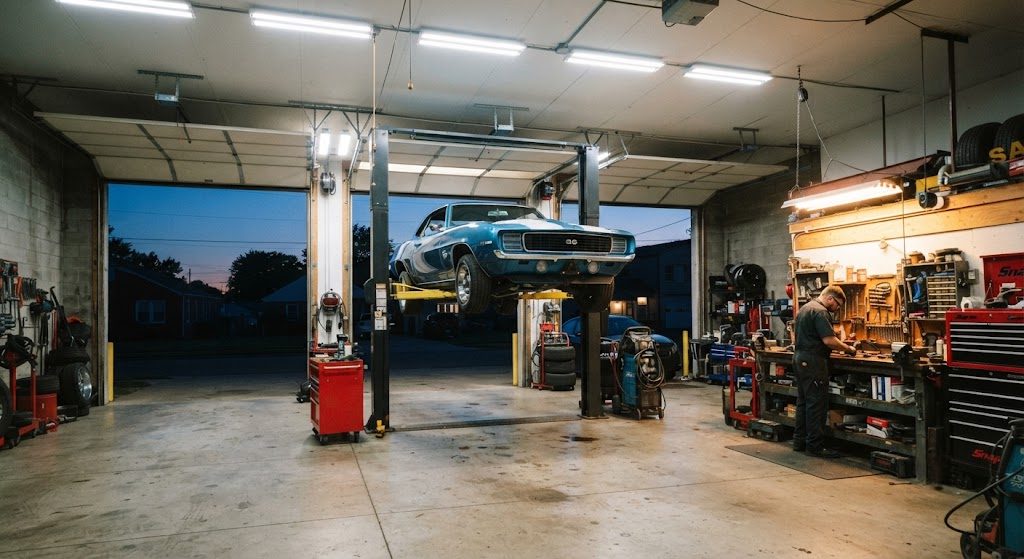
After I killed those old fluorescents, I switched to zone lighting. Each bay and work area gets its own lights, controlled independently. I don't light the whole shop when I'm only working in one bay at midnight. Here's how it's laid out.
Overhead Flood Lighting for the Bays
Each bay has two 4-foot LED strip lights mounted directly over where a vehicle sits, positioned slightly forward of center so the light falls into the engine bay when the hood is open. I went with 5,000-lumen fixtures in a 5000K color temperature — bright white, not that warm yellow that makes everything look like a living room. The strips are linked together so one switch controls the bay I'm working in.
The difference was immediate. I could see the oil filter without a drop light. I could read the dipstick without walking to the door for daylight. I stopped losing screws because they weren't disappearing into shadows anymore.
Task Lighting Over the Workbench
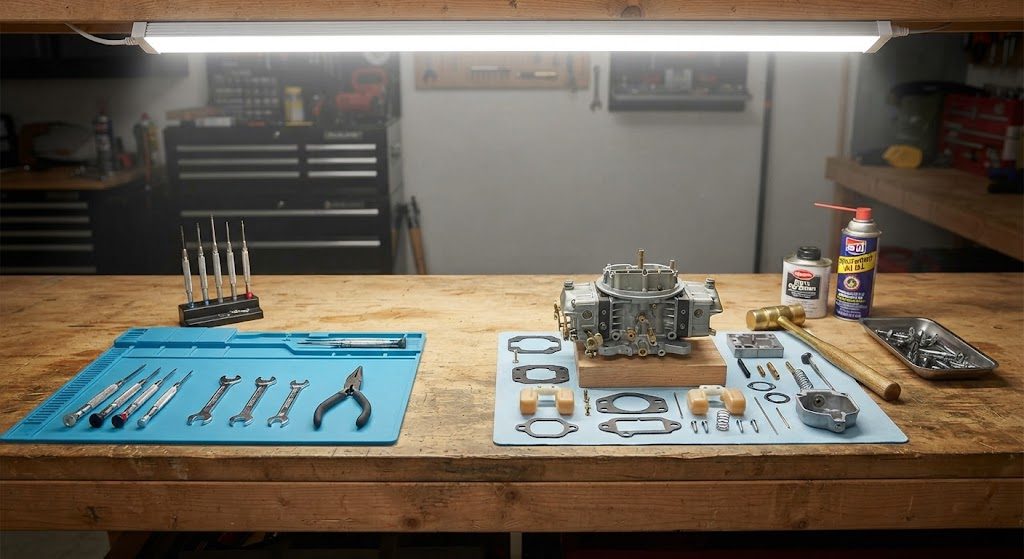
The workbench has its own light — a 4-foot LED fixture mounted 18 inches above the shelf, positioned forward so it throws light onto the work surface, not the back wall. This is where I rebuild carburetors, set float levels, and read the small print on parts labels. If I could only afford one upgrade in a home garage, it would be this. A properly lit workbench changes everything about what you can do in the space.
Lumens, Color Temperature, and the Numbers That Matter
Lighting specifications can feel like a foreign language, but two numbers actually matter for a working garage: lumens and Kelvin.
Lumens — How Much Light You're Actually Getting
Lumens measure total light output. For a workspace where you're doing detailed mechanical work, you want at least 300 lumens per square foot at the work surface. A typical two-car garage is about 400 square feet, so you'd need roughly 12,000 lumens total. That's four 3,000-lumen fixtures spread across the ceiling, minimum. More is better, especially as you get older and your eyes need more help.
Color Temperature — 5000K Is the Sweet Spot
Color temperature measures how warm or cool the light looks. 2700K is a living room lamp. 5000K is daylight at noon. For a garage, 4000K to 5000K is where you want to be. It renders colors accurately — red wires look red, green coolant looks green — and it keeps you alert during late-night work sessions. I tried 6500K once and it felt like a hospital operating room. 5000K is natural without being clinical.
What I'd Do Differently If I Were Starting Over
If I were wiring a garage from scratch tomorrow, I'd do two things different. First, I'd install more circuits. Having all the lights on one switch means you can't work in a single zone without lighting the whole place. Second, I'd put the overheads on dimmers — not because I want mood lighting in the shop, but because some tasks don't need full brightness and your eyes will thank you at 11 p.m.
Leo Chase lit his home garage with cheap shop lights from the home center, and they worked fine for five years until the plastic housings started yellowing and cracking. He replaced them with the same LED strips I use and told me he should have done it from day one. Good lighting isn't a luxury. It's the thing that makes every other project possible.
A garage that's dark is just a storage unit with better shelving. Light it like you mean to work in it.