Every couple of years, somebody tells me I should expand. A vendor, a well-meaning customer, my accountant one January when business was good. "Add a couple bays," they say. "Hire another tech. You're leaving money on the table."
They're right about the money. They're wrong about everything else.
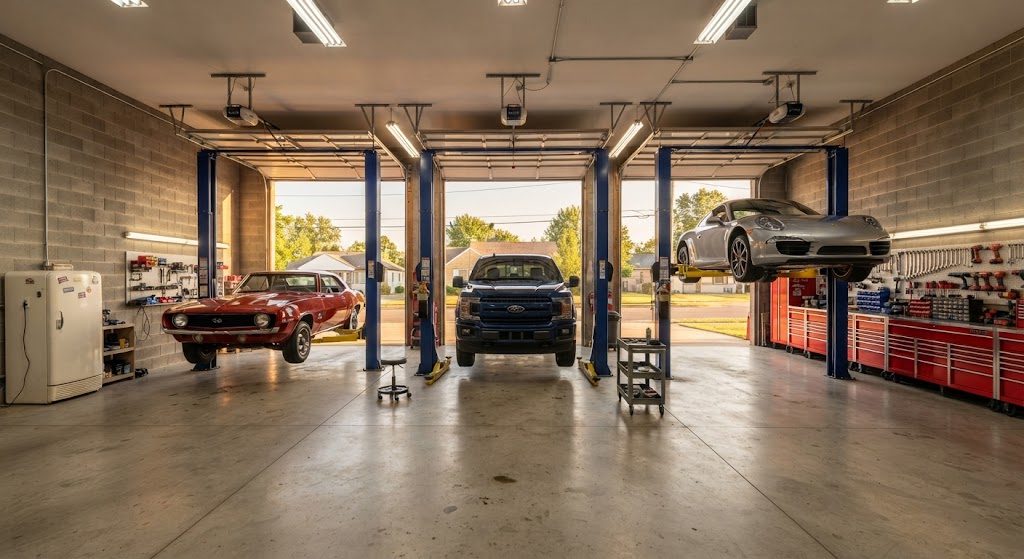
I opened Callahan Auto Works in 2016 with three bays. As of today, it still has three bays. That number isn't an accident or a budget constraint I haven't overcome yet. It's the number I chose, and I've defended it more times than I've had to defend a diagnosis. The size of a garage determines everything — how you work, what you take on, whether the space feels like a sanctuary or a factory. Three bays is my right size.
The Math of Staying Small
Every bay you add costs more than the concrete it sits on. It costs heat in the winter, light year-round, and the mental bandwidth of knowing what's happening in every corner of the shop. When I had seventeen years at the dealership, I worked in a facility with twenty-four bays. I know what scale does to a workspace. It turns a garage into a warehouse.
One Man, One Brain, Three Lifts
I'm the only full-time mechanic in this building. That means at any given moment, I can only physically touch one car. The second bay holds the next job, staged and ready. The third bay is for overflow — the long-term project, the emergency tow-in that shows up at 4 p.m., the Chevelle when the home garage is too cold to work in. Four bays would mean one sat empty most of the time. Five would mean I was running a parking lot.
Keeping it to three forces discipline. I don't overbook. I don't rush diagnostics to clear a bay. I don't let a car sit on the lift for three days waiting on parts while other work piles up behind it. The space dictates the pace, and the pace keeps the quality where I want it.
The Overhead You Don't See Coming
A fourth bay means another lift to maintain, another set of lights to wire, another corner of concrete to seal and sweep. The utilities tick up. The property tax assessor notices. The tooling you need to outfit another bay properly — a second transmission jack, more jack stands, another full set of air lines — eats whatever extra revenue that bay was supposed to bring in. Leo Chase ran a four-bay shop for three years before downsizing back to two. He told me the fourth bay made him more stressed and less profitable.
What the Extra Space Actually Costs You
Floor space is expensive, but that's not the real cost. The real cost is losing the feeling of a space that's fully yours, fully controlled, and fully understood.
Visibility Is a Safety System
Standing in the center of my shop, I can see every corner without moving. Bay One, Bay Two, Bay Three, the workbench, the parts shelf, the fridge. If a customer walks in, I see them. If a hose blows off a compressor line, I hear it and know exactly where it is. If smoke starts somewhere it shouldn't, I'm not running across six bays trying to find the source.
In a larger shop, you lose that. You rely on other people to watch the corners. And when you're a one-man operation like me, there are no other people. The three-bay layout is a safety net built into the floor plan.
The Garage Has a Personality — Don't Dilute It
Every garage feels like something. Some feel like chaos. Some feel like museums. Mine feels like a place where work gets done, where the radio is always on low, and where nobody's in a hurry to leave. That feeling comes from the scale. Stretch the same energy across five bays and it thins out. The place stops being a garage and starts being a facility. I've worked in facilities. I'm not going back.

What This Means for Your Home Garage
You don't need a commercial shop for this lesson to apply. The same logic scales down. A two-car garage that's trying to hold three vehicles, a workshop, and storage for everything you've owned since college is doing too much.
The Case for the One-Car That Works
I know guys with one-car garages who get more done than people with three-car garages and no floor space left. The difference is editing. A single bay with a workbench, a tool chest, and enough clear floor to walk around the car is a functional shop. A three-car garage packed to the rafters with junk is a storage unit that happens to have an overhead door.
If you're designing or reorganizing your garage, start by asking what you actually do in there. Park one car and change oil? One bay. Park two and restore a project on the side? Two, with a hard line between the daily side and the project side. Anything more than that, and you'd better have a reason that isn't "I might need the space someday."
The Space You Defend Is the Space You Keep
I've turned down jobs because they would have required a fourth bay. I've referred work to other shops when my schedule was full. That's not turning away money. That's protecting the garage I built. The three bays are the size that lets me do good work, know every inch of the floor, and go home at night not wondering what I missed.
Bigger garages exist. Smaller ones do too. This one is mine. And three bays is all the room I need.