Searching for car repair near me usually means something has already gone sideways. The starter clicks, the temperature gauge climbs, or the check-engine light comes on right before work. You need a shop, but you do not need a parts cannon disguised as a diagnosis. After years under hoods and on concrete floors, I have learned that finding a good mechanic is less about the fanciest waiting room and more about asking useful questions before anybody grabs a wrench.
Start With the Symptom, Not the Sales Pitch
Before calling around for car repair near me, write down exactly what the vehicle is doing. “It runs bad” is a starting point, not a diagnosis. Note when the problem happens, whether the engine is cold or warm, what speed you were traveling, and whether any warning lights appeared. A rhythmic thump at 40 mph points the technician in a different direction than a vibration only under braking.
Take a quick look under the hood if you are comfortable doing it. Check the oil level, coolant level, battery terminals, and visible belts. Do not crawl underneath a vehicle supported only by a jack. If you see coolant on the driveway, smell raw fuel, hear a deep knocking sound, or see the oil-pressure light, stop driving and arrange a tow. A $100 tow can beat turning a manageable repair into a destroyed engine.
When a shop asks what happened, give the timeline instead of guessing at the failed part. Tell them whether the battery went dead after sitting, whether the noise changes with engine speed, or whether the brakes pull left. Good information saves diagnostic time. At $100 to $180 per labor hour in many American markets, a clear description can save more than arguing over a small parts discount.

How to Screen a Shop Before the Appointment
A good search for car repair near me should produce several candidates, not one random listing with the most stars. Read recent reviews for details about communication, estimates, warranty handling, and completed work. “Great service” tells you little. A review describing an intermittent electrical problem, a clear explanation, and a vehicle returned when promised is much more useful.
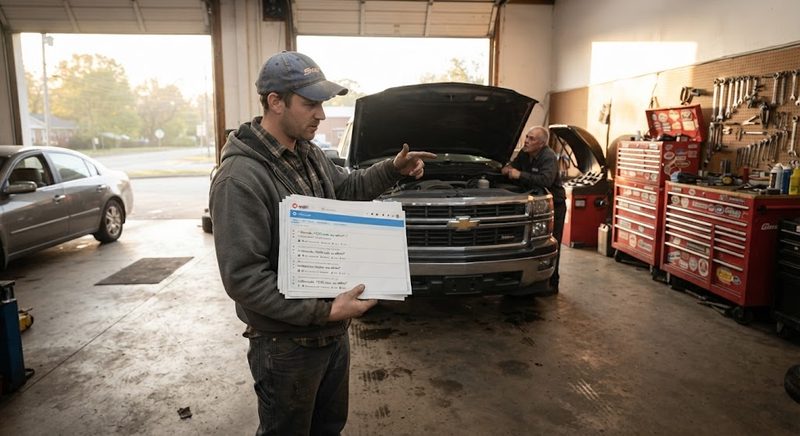
Call two or three shops and ask how they handle diagnosis. A professional answer sounds like this: they will inspect the vehicle, document test results, explain the likely cause, and request approval before performing additional work. Be cautious if someone quotes a major repair from one sentence over the phone. A failed alternator, for example, should be confirmed with charging-system tests rather than declared because the battery is weak.
Ask whether the shop has experience with your vehicle. A 2018 Ford F-150, a 2004 Honda Accord, and a modified 1972 Chevelle do not present the same problems. Independent shops can be excellent with older cars and common domestic platforms, while a dealer may have deeper access to factory software and brand-specific service information. The right choice depends on the job, not the logo over the door.
Also ask about the parts they install. Original equipment parts are not always necessary, but the cheapest online component is often false economy. A reputable shop should be able to explain whether it uses original equipment, established aftermarket brands such as Denso, Bosch, Timken, or Motorcraft, and what warranty comes with the part and labor. Get that answer in writing on the estimate.
Read the Estimate Like a Mechanic
When comparing car repair near me options, compare estimates line by line. Labor hours, diagnostic fees, shop supplies, taxes, parts brands, and warranty terms can make two totals look more different than they really are. A $900 quote with a two-year parts warranty may be a better deal than a $700 quote built around a questionable component and no clear labor coverage.
A proper estimate should identify the concern, the recommended repair, the parts, labor, and the total expected price. It should also separate urgent safety work from maintenance that can wait. Worn brake pads and a leaking master cylinder deserve immediate attention. A dirty cabin air filter does not. Do not let a service writer bundle five unrelated recommendations into one frightening total without explaining the order of importance.
For a common brake job, you might see roughly $250 to $600 per axle depending on vehicle, rotor condition, and parts quality. A battery replacement could be $150 to $350, while a diagnostic visit might run $100 to $200 before repairs. These are broad working ranges, not promises. Luxury vehicles, rust belt corrosion, hybrid systems, and performance modifications can move the number quickly.
If the vehicle needs more work than expected, the shop should contact you before crossing the approved amount. That phone call protects both sides. I have seen a simple suspension repair uncover a seized fastener, a damaged knuckle, and an alignment problem. The honest move is to stop, show the customer the evidence, and explain the choices rather than quietly adding charges.

When the Repair Is Worth Doing
The question is not simply whether a repair costs more than the car is worth according to an online value guide. Consider the vehicle’s rust, maintenance history, tires, transmission behavior, and replacement cost. Spending $1,200 on a known car with a solid body can make more sense than buying another used vehicle for $14,000 and immediately discovering worn suspension, old tires, and neglected fluids.
Use a rough three-part test. First, is the repair solving the actual problem, or is the shop guessing? Second, are there other major failures coming soon? Third, can the vehicle safely support your daily driving needs after the work? A clean diagnostic process matters more than a cheap first quote.
For a project car, the math changes again. A 1970s muscle car may need $3,000 in brakes, fuel-system work, and cooling repairs before it is roadworthy, but those improvements can support the whole build. Do not spend restoration money on shiny accessories while the wiring, tires, and brake hydraulics remain unsafe. Chrome does not stop a Chevelle, Camaro, or C10.
DIY Checks That Help Without Creating Trouble
If you are comfortable with basic maintenance, you can do useful checks before seeking car repair near me. Record trouble codes with a quality scan tool, but do not assume the code names the failed part. A P0301 code indicates a cylinder-one misfire; it does not automatically condemn the injector. Spark, fuel, compression, wiring, and air leaks can all be involved.
Take photographs of leaks, damaged connectors, tire wear, and warning messages. Save old parts and ask to see replaced components when practical. You can also check tire pressure, inspect tread, listen for wheel-bearing noise in a safe location, and verify that brake fluid is between the marked lines. Never bypass a warning light or continue driving just because the car still moves.
The best DIY contribution is accurate information and sensible maintenance. Bring service records, mention recent work, and tell the technician about modifications. A new intake, remote starter, lift kit, trailer wiring, or stereo installation can change the diagnostic path. Hiding those details wastes time and can lead to the wrong repair.
Finding Reliable Car Repair Near Me Today
The strongest car repair near me search ends with a shop that communicates before, during, and after the job. Look for a written estimate, clear approval limits, qualified technicians, sensible parts choices, and a warranty you understand. A clean floor and free coffee are nice, but neither one proves the person at the lift knows why your engine is missing.
Call with the symptom, ask how diagnosis works, and compare the explanation as carefully as the price. If the shop cannot explain the failure in plain English, keep looking. Once you find a mechanic who tests before replacing parts and treats your vehicle like more than an invoice, save the number. Reliable help is worth remembering, especially when the next warning light appears on a cold morning.