When a car starts slipping between gears, making a hard bang, or refusing to move, searching for a transmission shop near me is usually done with one hand on the phone and the other on the shifter. I get it. Transmission trouble has a way of turning a normal Tuesday into a four-figure problem before lunch. The good news is that the first shop you find does not have to be the shop you trust. A few smart questions can separate a real diagnostic operation from a parts cannon with a fancy sign.
Start With the Symptoms, Not the Sales Pitch
Before calling a transmission shop near me, write down exactly what the vehicle is doing. Note whether the problem occurs cold, after the car warms up, during acceleration, or while backing up. A slipping transmission may flare in engine speed without matching road speed. A failing torque converter can shudder at cruising speed. A bad transmission mount can create a clunk that sounds much worse than the actual gearbox problem.
Look underneath for red, brown, or dark fluid. Automatic transmission fluid is often red when fresh, though color alone does not prove its condition. A low fluid level can cause delayed engagement and slipping, but adding fluid is not a complete repair if the leak is still running down the bellhousing or crossmember. On a manual car, hard shifting might point to a clutch, hydraulic issue, worn synchronizer, or internal transmission damage. Those are different repairs with very different bills.
Bring the technician useful information: mileage, service history, recent towing, modifications, and whether the symptom began after a battery replacement or other work. Good details save diagnostic time and keep the conversation grounded.
What a Good Transmission Shop Should Do First
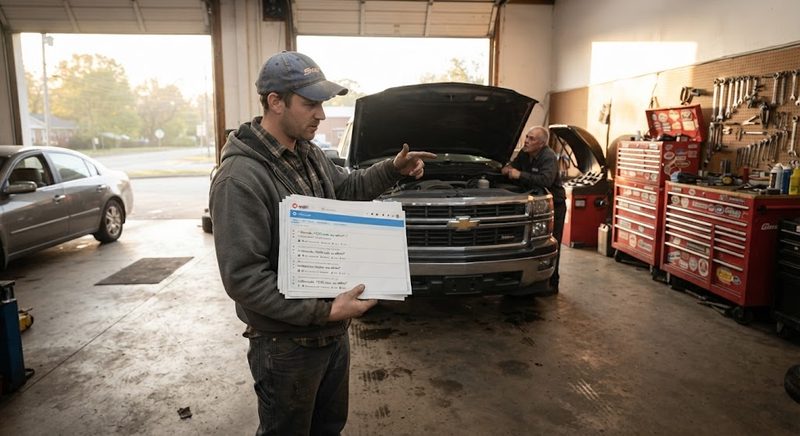
A trustworthy transmission shop near me should begin with diagnosis, not a rebuild quote. The technician may road-test the vehicle, scan for powertrain codes, inspect fluid level and condition, check linkage or electronic controls, and look for leaks. On older vehicles, a pressure test can reveal whether the pump, valve body, or clutch circuits are doing their jobs. No single test tells the whole story, but several findings together usually point in the right direction.
Ask whether the diagnostic charge is separate from repair labor. A fair shop will explain the fee, what it includes, and whether it is applied to the final bill. Expect a basic diagnostic visit to cost roughly $100 to $200 in many areas, with deeper testing costing more. That is cheaper than approving a $4,000 rebuild based on a guess.
Be cautious when a service writer declares the transmission dead without a road test, scan, inspection, or explanation. Sometimes the problem really is internal. Sometimes it is a $250 solenoid, a damaged wiring connector, a leaking cooler line, or an engine issue that feels like a shift problem. The paperwork should connect the symptom to the recommended repair.
Compare Estimates Without Comparing Apples to Rocks
When you call a transmission shop near me, request a written estimate that separates parts, labor, shop supplies, fluids, programming, taxes, and warranty terms. Ask whether the quote covers removal and installation, not just the rebuilt unit. A low price can become expensive if the shop adds a torque converter, cooler flush, seals, mounts, or computer relearn after the car is already apart.
For a conventional automatic, repairs can range from several hundred dollars for a leak or sensor to $1,500 or more for valve-body work. A full rebuild or replacement often lands around $3,000 to $7,000, depending on the vehicle, transmission design, parts quality, and local labor rate. A late-model truck, performance car, or European vehicle can run higher. A used unit from a salvage yard may cost less up front, but mileage and warranty coverage are major questions.
Ask whether the shop uses new, remanufactured, or used parts. Companies such as Jasper and other remanufacturers offer different warranty programs, while a local builder may tailor a unit for a modified vehicle. The right choice depends on the car and your budget, not just the biggest warranty number printed on a brochure.
Questions Worth Asking Before You Approve Work
A reputable transmission shop near me should answer direct questions without acting offended. Ask who will perform the diagnosis, whether the technician has experience with your transmission family, and what failed parts will be shown to you. Ask how the shop handles comeback repairs and whether the warranty covers labor as well as parts. A parts-only warranty can leave you paying thousands in labor if the replacement unit fails.
Find out whether the vehicle needs a cooler flush, updated software, adaptive shift relearn, or a break-in procedure after installation. Many modern transmissions depend on electronic controls, and replacing hardware without completing the required programming can create new shift complaints. On a classic car, the equivalent might be adjusting a kickdown linkage, setting vacuum control, or correcting a worn shifter mount.
Do not let anyone scare you with vague language such as “it needs a transmission” when the actual recommendation is not written down. You are allowed to take the estimate home, call another shop, and think for an evening.

Local Reputation Matters More Than a Shiny Waiting Room
The best way to judge a transmission shop near me is to look for consistent, specific feedback. Reviews that mention clear estimates, communication, warranty handling, and completed repairs are more useful than a pile of five-star ratings with no details. Ask at a local parts counter, car club, Cars and Coffee gathering, or independent repair shop that does not perform transmission work. Technicians usually know who does careful work and who specializes in comebacks.
Look at the facility if you can. A clean floor is nice, but it is not proof of skill. Pay attention to whether the shop has proper lifts, scan tools, transmission jacks, fluid service equipment, and a place to document removed parts. Ask where the vehicle will be stored overnight. A serious operation should also provide a real business address, a written authorization process, and a clear way to reach the person responsible for the repair.
National chains can be convenient and may offer standardized warranty programs. An independent specialist may provide more direct communication or deeper experience with older and modified vehicles. Neither sign guarantees quality. The technician’s process matters more than the logo over the door.
Protect the Car Before It Reaches the Bay
If the transmission is slipping badly, smoking, leaking heavily, or refusing to engage, driving it farther can turn a repairable problem into a destroyed core. Call the transmission shop near me and ask whether the vehicle should be towed. A local tow commonly costs around $75 to $150 before extra mileage, while one overheated clutch pack can add thousands to the repair.
Remove personal items, photograph the vehicle, record the mileage, and keep receipts for recent work. Tell the shop about aftermarket tuning, larger tires, towing equipment, or a recent fluid change. Those details affect diagnosis. Do not authorize teardown until you understand the inspection charge and what happens if you decline the repair after disassembly.
If you are comfortable with basic work, check the fluid level only according to the manufacturer’s procedure. Some newer transmissions have no dipstick and require a specific temperature range for level checking. Guessing with the wrong fluid or dumping in an additive from the parts store can create more trouble. The bottle promising a “permanent fix” is usually the cheapest part of an expensive mistake.
Make the Call With a Clear Head
Searching for a transmission shop near me does not mean handing over blind trust. Describe the symptom, ask for a diagnostic plan, compare written estimates, and get warranty details before approving anything. The right shop will tell you when a rebuild makes sense, when a used unit is a gamble, and when the transmission is not actually the problem.
That straightforward process protects your money and your car. Whether you are keeping a daily-driven Silverado alive, sorting out a temperamental Mustang, or getting an old Chevelle back on the road, find a technician who explains the failure in plain English. A shop that earns the repair earns the repeat business. That is how a garage relationship ought to work.