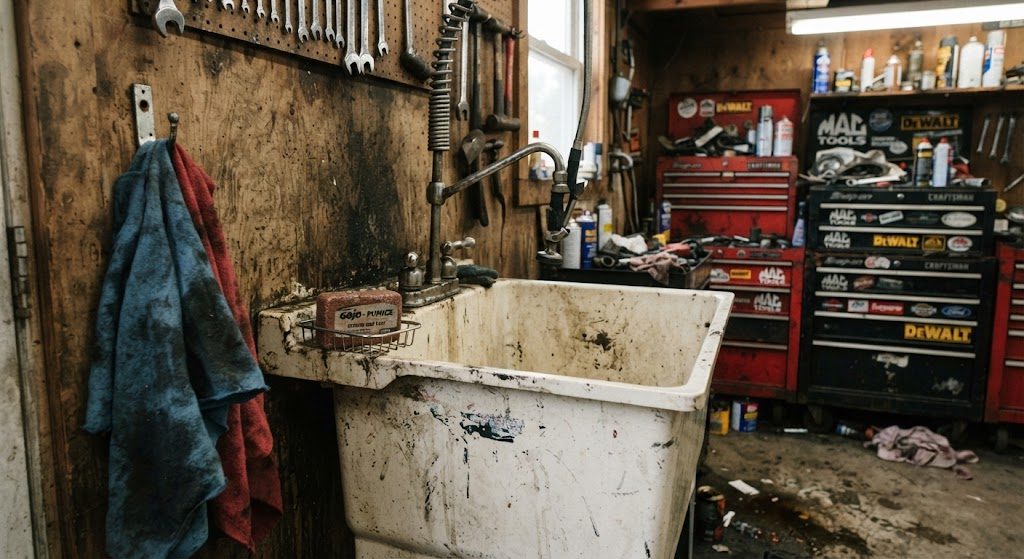
The first time I scrubbed gear oil off my hands in the kitchen sink, my wife didn't say a word. She didn't have to. The smell traveled through the whole house, the drain was greasy for a week, and the dish sponge was permanently retired. That was nineteen years ago, in a single-car garage with no plumbing and no plan for where the grime was supposed to go.
A garage sink isn't a luxury. It's the barrier between your workspace and your living space. Every time you wash up in the garage, you're not washing up in the house. That sounds obvious, but you don't realize how much it matters until you've walked through the kitchen with black hands one too many times. When I opened the shop in 2016, a utility sink was on the must-have list right next to the lift and the fridge.
Where to Put the Sink
Placement matters more than you think. A sink tucked in a corner you can't reach with dirty hands is a sink that never gets used. Put it where the work happens, or as close to that as plumbing allows.
The Walk-Through Rule
Your sink should sit between the work area and the door to the house. That way you pass it on the way in, not on the way out. In my shop, the sink is on the wall between Bay One and the bathroom — a straight line from the lift to the faucet. I can wash my hands before I touch a door handle, a light switch, or the fridge. That sequence matters. Grease migrates. Give it a chance, and it'll be on every surface you own by the end of the week.
In a home garage, the same rule applies. If your garage connects to the house through a mudroom or laundry room, put the sink on the garage side of that door. If you've got a detached garage, put the sink next to the main workbench. Keep the path from work to water as short as possible.
Plumbing Reality Check
You need a water supply line and a drain. In an attached garage, you can often tap into the house plumbing through a shared wall. Hot water is ideal, but cold-only is still a huge upgrade over no sink at all. I ran cold-only in my home garage for years and heated water on a hot plate when I needed it. It wasn't perfect, but it was better than walking through the snow to the house with brake fluid on my hands.
In a detached garage, plumbing gets more complicated. You're either trenching a line from the house — expensive but permanent — or running a seasonal setup with a garden hose connection and a bucket drain. The bucket setup costs about forty dollars and works from spring through fall. In winter, you drain the line and shut it down unless you've got a heated building.
The Basin and Faucet That Actually Work
A garage sink is not a kitchen sink. It doesn't need to be pretty. It needs to be deep, hard to damage, and big enough to fit a cylinder head if that's what you're cleaning.
Deep Basin Over Everything
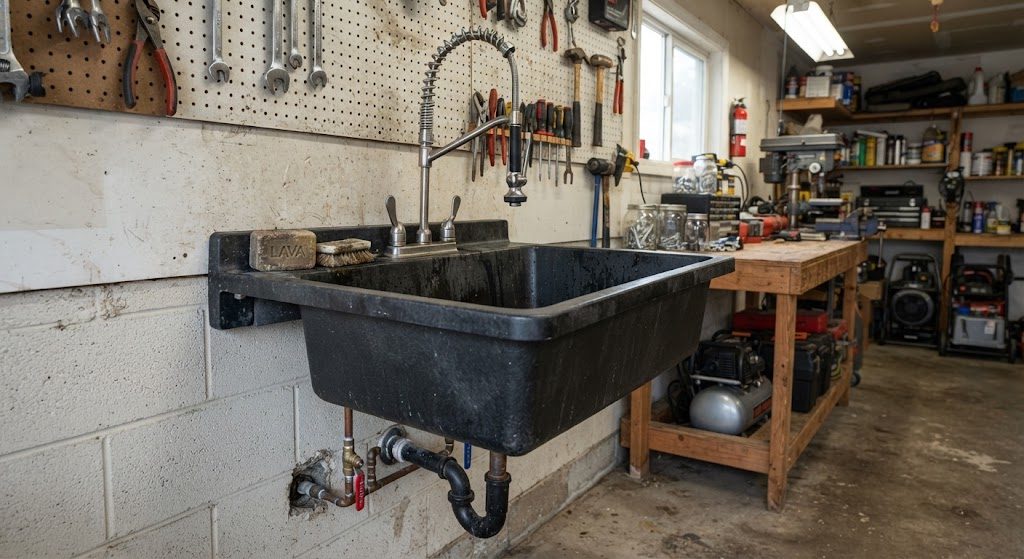
Utility sinks come in polypropylene, fiberglass, and stainless steel. Polypropylene is the cheapest and the best for a garage. It doesn't rust, doesn't crack when you drop a brake caliper in it, and doesn't care what chemicals go down the drain. Fiberglass stains. Stainless steel dents. A basic deep-basin utility tub from the home center, the kind with legs and a 20-gallon capacity, will outlast your interest in replacing it.
The depth is the thing. A shallow sink splashes water everywhere and can't hold a five-gallon bucket for filling or draining. A deep basin lets you submerge parts, wash out a shop towel, and scrub up to your elbows without splashing the wall. Mine has caught everything from carburetor cleaner to transmission fluid, and it still holds water like the day I installed it.
The Faucet — High Arc, Pull-Out Sprayer
A standard kitchen faucet is too low. You can't get a bucket under it, and you can't rinse a large part without hitting the spout. A high-arc utility faucet with a pull-out sprayer solves both problems. The sprayer reaches the corners of the basin for cleaning, and the height clears a bucket with room to spare.
I added a simple ball valve before the faucet on my cold line. It acts as a shutoff and a flow control. If I'm washing something delicate, I throttle it back. If I'm filling a bucket, I open it all the way. Ten dollars in brass fittings.
Draining It Without Ruining the Plumbing
What goes down a garage sink is not the same as what goes down a kitchen sink. Oil, solvents, paint residue, metal particles — none of that belongs in a septic system or a municipal sewer line. I keep a five-gallon bucket under the sink drain when I'm washing parts. The bucket catches the heavy stuff, and I pour off the water into a gravel patch outside once the solids settle. The chemicals and oils go to the county hazardous waste drop-off twice a year.
If you plumb the sink to a permanent drain, install a sediment trap — a small basin that catches solids before they hit the pipe. You can buy one for under thirty dollars. Clean it out once a month. It'll save you a plumber's visit when the drain inevitably clogs with grease and metal shavings.
What a Sink Changes About the Garage
The sink turned my shop from a room where work happened into a room where work could happen cleanly. I wash my hands six times a day in there — before lunch, after a messy job, before I touch a customer's interior, before I head home. Multiply that by twenty years, and that's thousands of trips I didn't make into the house with dirty hands.
A garage sink isn't glamorous. It's not a floor coating or a lighting grid. Nobody walks into the shop and says "nice sink." But they notice when it's not there, because the mess follows you inside. Put one in. Your kitchen counters will thank you.