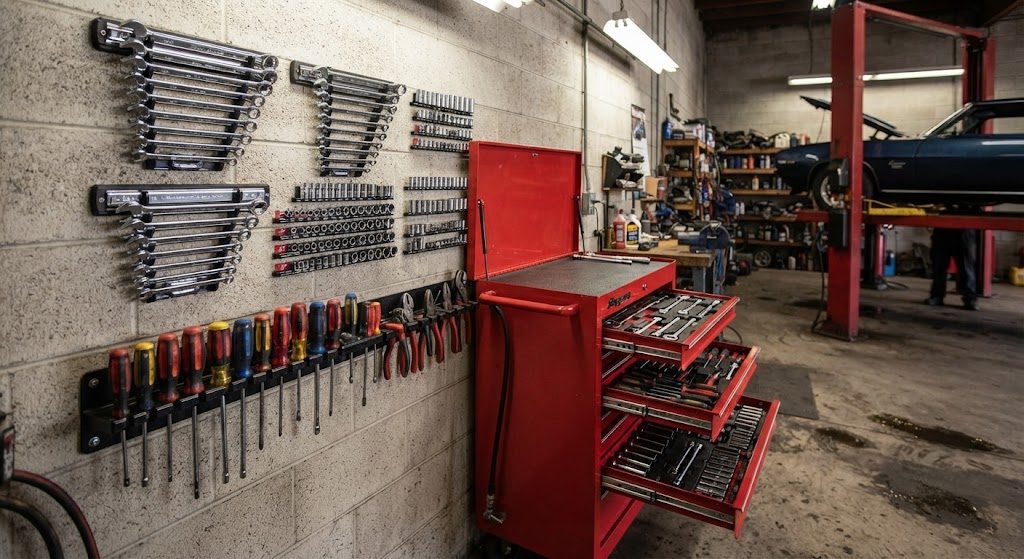
The moment I knew my tool organization was broken came in 2018, two years after I opened the shop. I was halfway through a water pump replacement on a customer's Tahoe, and I spent more time walking across the shop to grab wrenches than I did turning them. My socket rails were a mess — three different brands, sizes mixed together, half the clips broken. My screwdriver drawer looked like a utensil drawer after Thanksgiving dinner. Nothing had a home.
A disorganized garage isn't just annoying. It costs you time. And time is the one thing you can't buy more of when a customer's waiting and the truck's blocking a bay. That night I cleared the schedule, poured a beer, and spent four hours rethinking every tool in the shop.
The Wall Is Worth More Than the Floor
Most guys organize from the tool chest outward. They buy a bigger box, stuff it full, and call it done. I went the other direction. The wall became my primary storage, and the chest became secondary. That shift alone saved me more steps than any piece of equipment I've ever bought.
Magnetic Rails for Wrenches — Within Arm's Reach
The first thing I did was mount three 24-inch magnetic rails on the wall between Bay One and Bay Two, right above the workbench. All my combination wrenches live there now, metric on the left rail, SAE on the right, stubby wrenches in the middle. They're arranged in ascending order, smallest to largest, open end pointing down. I can see every size without digging. If a wrench is missing, I know immediately.
Magnetic rails beat wrench racks because they don't care about thickness. A 7mm sits next to a 19mm without any plastic clips cracking. They also hold tight when the compressor kicks on and the whole wall vibrates. Leo Chase saw my setup and stole the idea for his own garage the next weekend.
Pegboard Is Not Dead — You Just Used It Wrong
Above the main workbench, I hung a 4-foot-by-4-foot sheet of 1/4-inch pegboard, but not the flimsy stuff from the home center. This is tempered hardboard painted flat black, screwed into studs with 2-inch standoffs so the hooks have room behind. Pliers, cutters, pry bars — anything with a hole in the handle goes on the board.
The trick nobody tells you about pegboard is that the hooks need to be secured. A dab of hot glue where the hook meets the board keeps them from pulling out every time you grab a tool. I learned that after the third time I reached for a pair of needle-nose and brought the hook with them.
The Tool Chest Layout That Finally Clicked
Once the wall took the high-use tools, the tool chest could breathe. Every drawer got a purpose, and that purpose hasn't changed in six years.
Top Drawer — Sockets Only, Nothing Else
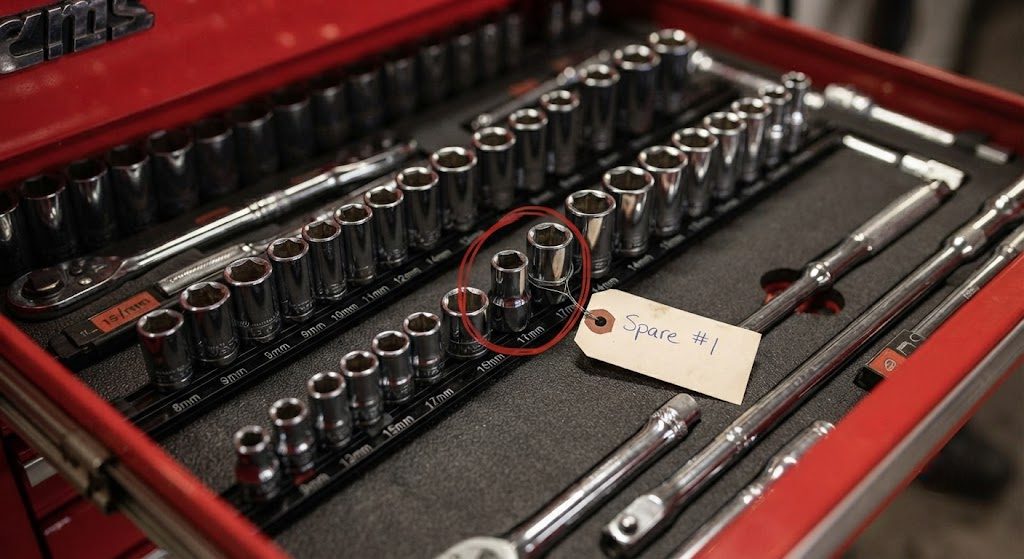
The top drawer is the most valuable real estate in any chest. In mine, it's sockets. All of them. I arranged them on twist-lock socket rails with the size labels facing up — 1/4-inch drive on the left, 3/8 in the middle, 1/2 on the right. Shallow and deep in separate rows. The rails lock together so they don't slide around when the drawer opens. Impact sockets live in a separate drawer one level down because they're heavy enough to turn the rails into missiles if I open the drawer too fast.
The 10mm Problem — Solved
Every mechanic knows the 10mm socket is the first to disappear. I keep three of them. One on the main rail in the top drawer, one on a magnetic strip mounted inside the cabinet door, and one in a small magnetic tray that lives on the side of the lift. I haven't lost a 10mm in five years, and I say that without knocking on wood.
Workbench Discipline — What Goes There and What Doesn't
A workbench is not a storage shelf. I had to learn that the hard way. When I first set up the shop, the bench accumulated everything — parts, bolts, coffee cups, half-empty oil bottles. By the end of the week, I'd have cleared just enough space to work, and the cycle would repeat.
Now the bench has a rule: nothing stays on it that isn't part of the current job. When I'm rebuilding a carburetor, the bench holds the carb, the rebuild kit, and the tools for that job. When I'm done, everything goes back to its home. The bench gets wiped down and goes bare until the next project. It's the simplest system I've ever used, and it works because there's no inventory to manage — just a flat surface and the discipline to keep it that way.
The Shelf Above the Bench
I installed a single shelf above the bench, 8 inches deep, painted to match the pegboard. It holds the things I need for almost every job: a can of brake cleaner, a roll of shop towels, a tube of anti-seize, a magnetic parts tray. If I use it more than twice a day, it lives on that shelf. Everything else goes in a drawer.
Know Your Layout Before You Lock It In
Every garage is shaped different. Mine is a rectangle with three bays side by side, which means I can walk from one end to the other in about twelve steps. Your garage might be a single-car box or a detached pole barn. The principle is the same: high-use tools go closest to the work zone, wall space is precious, and every step you eliminate is a minute you get back.
I've reorganized my shop three times since 2016. The current layout has held since 2019, and I don't plan on changing it. The wrenches are on the wall. The sockets are in the top drawer. The 10mm has a spare. And when I reach for a tool, my hand knows where it is before my brain does.
That's not Instagram-pretty. It's better.